Why Most AI Projects Fail in Indian Companies, and the Data Layer Nobody Budgets For
Research shows 70% to 85% of enterprise AI projects fail. Here are the real causes from RAND, MIT and Gartner, what AI ready data means, and how to structure a project that works.
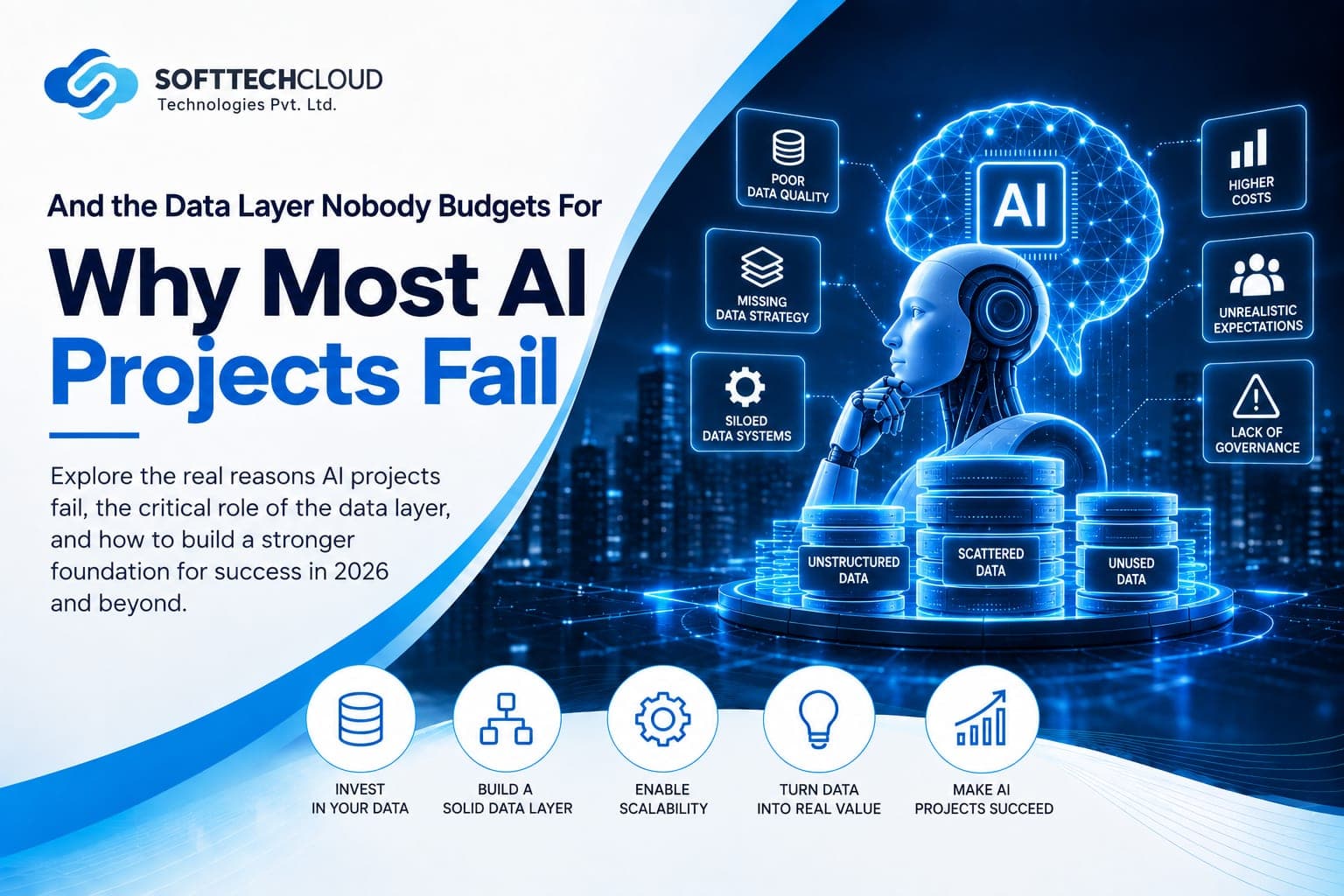
Independent studies from RAND, MIT, Gartner, BCG and McKinsey all land in the same range. Roughly 70% to 85% of enterprise AI initiatives fail to deliver their intended value, and MIT research found around 95% of generative AI pilots produced no measurable profit and loss impact. The causes are consistently organisational and data related rather than technological. RAND attributes about 84% of failures to leadership decisions, and Gartner projects that 60% of AI projects lacking AI-ready data will be abandoned through 2026. The model is almost never the problem.
This is the article your AI vendor will not write for you. India is adopting AI faster than the global average, which means Indian companies are also failing at it faster than most. The uncomfortable part is that the failures are not caused by bad models or bad luck.
The good news is that the failure patterns are well documented and boringly consistent across every major study. That makes them avoidable, provided you know what to look for before you sign anything. This guide gives you the numbers, the real causes, a ten-question diagnostic you can run on any proposal, and a project structure that actually reaches production.
Quick Stat (2026): RAND reports that more than 80% of AI projects fail to deliver intended business value, roughly twice the failure rate of comparable IT projects without AI. MIT's Project NANDA found around 95% of generative AI pilots delivered no measurable impact on profit and loss.
1. The Numbers, From Five Independent Studies
Different methodologies, different sample sizes, and the same conclusion every time.
| Source | What they found |
|---|---|
| RAND Corporation | More than 80% of AI projects fail to deliver intended business value, roughly twice the failure rate of comparable IT projects |
| MIT Project NANDA | Around 95% of generative AI pilots delivered no measurable profit and loss impact. Only about 5% captured value at scale |
| Gartner | 60% of AI projects lacking AI-ready data will be abandoned through 2026 |
| BCG | 80% of AI projects fail to scale beyond the pilot phase, with an average pilot-to-production timeline of 18 to 24 months |
| S&P Global | 42% of companies abandoned most AI initiatives in 2025, up from 17% the previous year |
That last figure deserves attention. Abandonment more than doubled in a single year, and not because models got worse. It doubled because the honeymoon ended and finance departments started asking for numbers.
One statistic is worth isolating. RAND attributes roughly 84% of AI project failures to leadership decisions rather than technical limitations, unclear success metrics, weak sponsorship, and treating AI as an IT exercise instead of a change to how the business operates.
2. Why the Pilot Worked and Production Did Not
Almost every failed AI project has the same shape. The pilot was impressive, everybody was excited, and production either never happened or happened and quietly delivered nothing. The reason is structural, a pilot tests the model, production tests your data infrastructure.
In a pilot you hand the model a curated dataset, a narrow task and a friendly evaluator. In production it meets your actual data, which is duplicated across an ERP and a legacy system, inconsistently coded, missing for the last quarter, and locked inside an Excel approval chain with no API.
One documented production readiness assessment found 40% of product-level inventory data duplicated or inconsistently coded across systems, a quarter of cloud compute allocated to idle instances before AI workloads were even added, and twelve core procurement workflows still running on Excel-based approvals with no API exposure, making automation impossible without re-engineering the workflow first. None of those are model problems, all of them stop a project dead.
The cost gap is equally instructive. Moving the same system from proof of concept to production has been benchmarked at a 10 to 20 times cost increase, driven by data infrastructure, engineering, compliance and ongoing operations. Companies that budget for the pilot and not for the other 90% run out of money at exactly the point where value would have started.
3. The Five Failure Modes, Ranked
A 2026 survey of 650 enterprise technology leaders identified five causes accounting for the large majority of production failures.
- Integration complexity, cited by 63%, the AI works, but connecting it to the systems where work actually happens does not, due to legacy systems without APIs, undocumented data formats, and authentication that was never designed for machine access.
- Output quality degradation at scale, cited by 58%, accuracy that looked fine on 100 curated examples falls apart on 100,000 real ones, because real data is messier than test data.
- Insufficient monitoring, cited by 54%, teams cannot detect performance drift after launch, so the system degrades silently and nobody notices until a customer complains.
- Unclear ownership, cited by 49%, no named owner for AI behaviour after launch, so when output quality drops there is nobody whose job it is to notice or fix it.
- Domain-specific data gaps, cited by 41%, the model was never trained or grounded on the actual data the production task requires.
Notice what is missing from that list: model capability. In 2026, frontier models are not the constraint for the overwhelming majority of business use cases, the constraint is everything around them.
4. What AI-Ready Data Actually Means
'Clean your data' is advice everybody gives and nobody can act on. Here is the operational definition. Data is AI-ready when it is:
- Accessible, reachable through an API or a query, not locked inside a PDF, a screenshot or a spreadsheet on somebody's laptop; if a human has to fetch it, an agent cannot use it.
- Consistent, the same entity carries the same identifier everywhere. If a customer is CUST-4471 in the CRM, 4471 in billing and 'Sharma Enterprises' in the support system, every AI answer that spans those systems will be wrong in ways that are hard to detect.
- Documented, somebody can say what each field means, who owns it, and when it was last validated. Undocumented fields are the leading cause of confidently wrong AI output.
- Current, refreshed on a known schedule. AI grounded on stale data produces answers that are plausible, specific and out of date, which is the most dangerous combination available.
- Complete for the task, not complete in general, which is impossible, but complete for the specific decision the AI is being asked to support.
- Permissioned, with defined access rules so the AI cannot surface data to somebody who should not see it. This is where DPDP obligations and AI deployment meet directly; an assistant that cheerfully returns another customer's details is both an AI failure and a compliance breach.
Only a single-digit percentage of enterprises meet this bar at scale, against near-universal AI adoption, that gap is the entire story. Getting there is data engineering work: canonical identifiers, pipelines, documentation, and a system of record that other systems defer to. It is unglamorous, it rarely gets its own budget line, and it determines whether everything downstream works.
5. The Indian Context: Fast Adoption, Same Failures
India is not lagging on adoption. Deloitte's 2026 India findings report roughly 40% of Indian respondents at significant or full AI usage against a global average near 28%, and EY's outlook found 24% of surveyed enterprise leaders already deploying agentic AI.
Fast adoption combined with unchanged failure rates means more Indian companies are failing at AI right now than in any previous year. Three local factors sharpen the risk: speed is prioritised over foundations, since EY's survey found deployment speed rather than raw capability was the deciding factor in buy-versus-build for most leaders, a reasonable competitive instinct but a terrible sequencing decision when the data layer is not ready; systems are fragmented by growth rather than by design, since mid-market Indian companies typically grew through point solutions, a CRM here, a billing tool there, with Excel filling the gaps, rather than a canonical system of record; and compliance is arriving at the same time, with DPDP obligations landing in November 2026 and May 2027, so companies building AI on ungoverned data are building something they will have to rebuild.
The upside is real though. Organisational change lags model capability everywhere, so Indian mid-market companies that fix their foundations over the next twelve months will be genuinely ahead of peers who bought tools instead.
6. Why AI Agents Made This Worse, Not Better
As enterprises moved from simple chatbots to autonomous agentic workflows, reported failure rates climbed rather than fell. The reason is straightforward: a chatbot that gives a wrong answer produces a wrong answer, but an agent that acts on wrong data produces a wrong action, a purchase order raised, a record updated, a customer emailed. Agents do not tolerate data debt; they expose it, loudly, in front of customers.
Three specific ways agents amplify existing weakness:
- Compounding errors, a five-step workflow with 95% accuracy per step succeeds about 77% of the time from end to end.
- Silent failure, agents often produce plausible output when they should have stopped, and without monitoring, you learn about failures from customers.
- Permission sprawl, agents need broad system access to be useful, which turns every access control weakness into a live risk, which is why agent deployments need cyber security review before launch rather than after.
The practical conclusion is simple: do not deploy agents on a data layer that cannot support a chatbot. If your systems cannot reliably answer a question, they certainly cannot reliably act.
7. How SoftTech Cloud Technologies Helps You Get It Right
We get called in at two points, either before a project starts, which is cheap, or after a pilot has stalled, which is not. The diagnosis is almost always the same.
Our approach starts with a readiness assessment rather than a demo. We run your intended use case through the ten questions in the next section, identify what will break in production, and tell you honestly whether the foundation is ready. Where it is not, we fix it first through data engineering, building canonical identifiers, API access to the systems involved, field documentation and access rules scoped to that specific use case rather than a company-wide data programme nobody finishes.
Then we build narrow, one task, shadow mode first so accuracy data is gathered with zero production risk, and a control layer of logging, permission scoping and a kill switch built through our DevOps services. The deployment itself is usually an AI chatbot or a CRM automation, running on secure cloud infrastructure, with metrics reviewed weekly so the decision to expand or stop is made on numbers rather than enthusiasm.
Explore our full range of technology services, see our recent work, or talk to our experts for a free AI readiness assessment.
8. Ten Questions to Ask Before Approving Any AI Project
Run any proposed project through these. Three or more 'no' answers means fix the foundation before you build anything.
- Can you name the single business metric this project moves, and its current value?
- Is there one named person accountable for this system's output after launch?
- Is the data this needs accessible through an API or query, without a manual export?
- Does the same entity carry a consistent identifier across every system involved?
- Can somebody explain what each critical field means and when it was last validated?
- Do you know what a single completed task will cost at production volume?
- Is there a monitoring plan that detects quality degradation without a customer complaining?
- Is there a defined access boundary covering what this system can and cannot read or do?
- Is there a rollback plan and a kill switch that a non-engineer can operate?
- Have you budgeted for the 10 to 20 times gap between pilot and production?
Pro tip: Question 10 is the one that quietly kills projects. Most Indian mid-market AI budgets are pilot budgets with a production ambition attached, if the number in your proposal only covers the proof of concept, the project is already scheduled to stall.
9. What the Successful Minority Do Differently
The 5% to 20% that succeed share a small number of practices.
- They define the metric before the tool, not 'we want to use AI' but 'we want first response time under 10 minutes and we think AI is the way'. The metric survives even if the tool changes.
- They fix data infrastructure before the first pilot rather than after, slower to start and dramatically faster to finish.
- They give it a business owner with authority over process, not an IT owner, because AI projects change how work is done and somebody needs the authority to change it.
- They start narrow and boring, one task, one workflow, one measurable outcome; ambitious scope is the most reliable predictor of failure in the entire dataset.
- They instrument from day one, accuracy, cost per completed task, human intervention rate and drift; if you cannot measure it, you cannot defend the budget at renewal.
- They kill projects without sentiment, a discipline of stopping what does not work is what frees the budget for what does.
10. How to Structure an AI Project That Survives
- Phase 0, readiness, 2 to 4 weeks, run the ten questions above against your intended use case and fix the blockers. This phase feels like delay and is the reason the project will finish.
- Phase 1, data foundation, 4 to 8 weeks, canonical identifiers, API access to the required systems, field documentation and access rules, scoped to this use case only.
- Phase 2, narrow build, 4 to 6 weeks, one task, shadow mode first, where the system produces recommendations a human approves so you gather accuracy data with zero production risk.
- Phase 3, controlled rollout, 4 weeks, assisted mode, then limited autonomy with defined authority limits, logging, spend caps and a kill switch, with metrics reviewed weekly.
- Phase 4, decide honestly, did the metric from question 1 move? If yes, expand to the adjacent task; if no, stop and write down why. Both outcomes are worth the money, only ambiguity is not.
This is deliberately unexciting, and it is the difference between the 20% and the 80%. Teams that skip Phase 0 and Phase 1 to move fast reliably spend more time and more money arriving at a worse outcome.
11. Mistakes That Quietly Kill AI Projects
- Buying the tool before defining the metric, if nobody can say what number should move, nobody can say whether it worked.
- Treating it as an IT project, when it changes how work is done and needs an owner with authority over process.
- Budgeting for the pilot only, the pilot is roughly 10% of the total cost.
- Scoping too broadly, one task beats one department every time.
- Skipping shadow mode, two weeks of human-approved recommendations costs almost nothing and prevents customer-facing incidents.
- No monitoring, silent degradation is the default outcome, not the exception.
- Deploying agents on unready data, which turns data debt into visible, customer-facing failures.
- Refusing to kill a failing project, sunk cost keeps bad projects alive and starves good ones.
12. Final Thoughts: Boring Foundations Beat Exciting Pilots
There is a version of AI adoption that looks impressive in a board meeting and delivers nothing, and there is a version that looks slow for two months and then quietly compounds for years. The difference is almost never the model.
Every study points the same direction. The companies that win with AI are the ones that did unglamorous work first, cleaning identifiers, opening APIs, documenting fields, naming owners and instrumenting outcomes. None of that photographs well. All of it is why their pilots reach production while everybody else's do not.
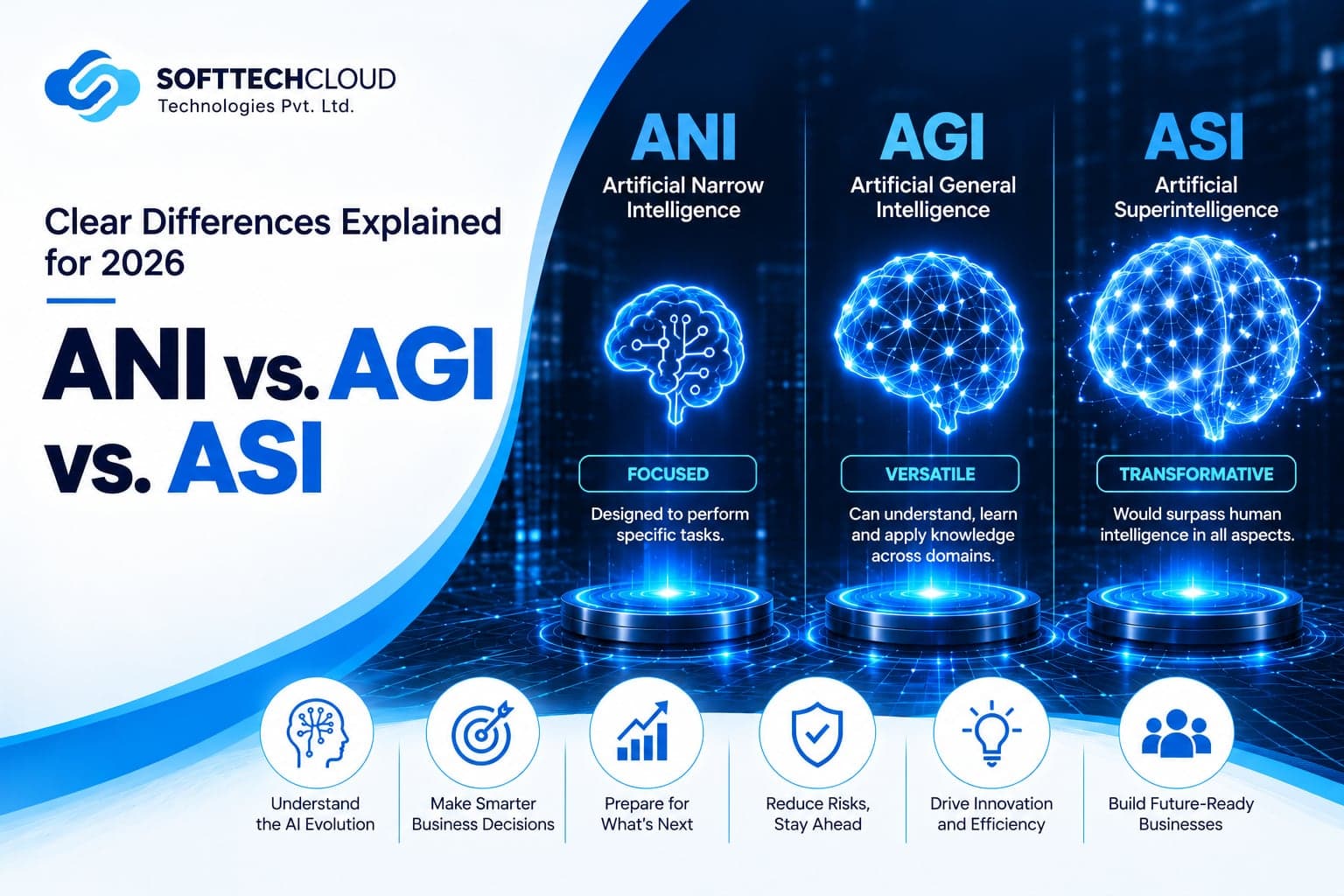
Pick one task. Run the ten questions honestly. Fix what fails. Then build small, measure properly, and expand only what the numbers justify. That approach is available to a 30-person company in Pune just as much as to a global enterprise, and right now it is the strongest competitive advantage on the table. To see where this fits in the bigger AI picture, read our guide to ANI, AGI and ASI.
13. Frequently Asked Questions
Across RAND, MIT, Gartner, BCG and McKinsey research, roughly 70% to 85% of enterprise AI initiatives fail to deliver intended business value. MIT's Project NANDA found around 95% of generative AI pilots produced no measurable profit and loss impact, with only about 5% capturing value at scale.
Because a pilot tests the model against curated data while production tests your actual data infrastructure. Integration complexity, inconsistent identifiers across systems, undocumented fields and missing API access stop projects that worked perfectly in a demonstration.
Data that is accessible through an API or query, consistent in how entities are identified across systems, documented so field meaning is known, refreshed on a known schedule, complete for the specific task, and permissioned so the AI cannot surface data to the wrong person.
Fix the data for the specific use case first. Companies that build the data foundation before the first pilot start slower and finish substantially faster, because the alternative is discovering the same problems later at production cost.
If your systems cannot reliably answer a question, they cannot reliably act. Confirm you have a repetitive documented task, accessible clean data, monitoring that detects degradation, defined access boundaries, a kill switch and a named human owner. Talk to our experts for an AI readiness assessment.
Content & Strategy
More From The Team
A few related posts, picked from the same beat.