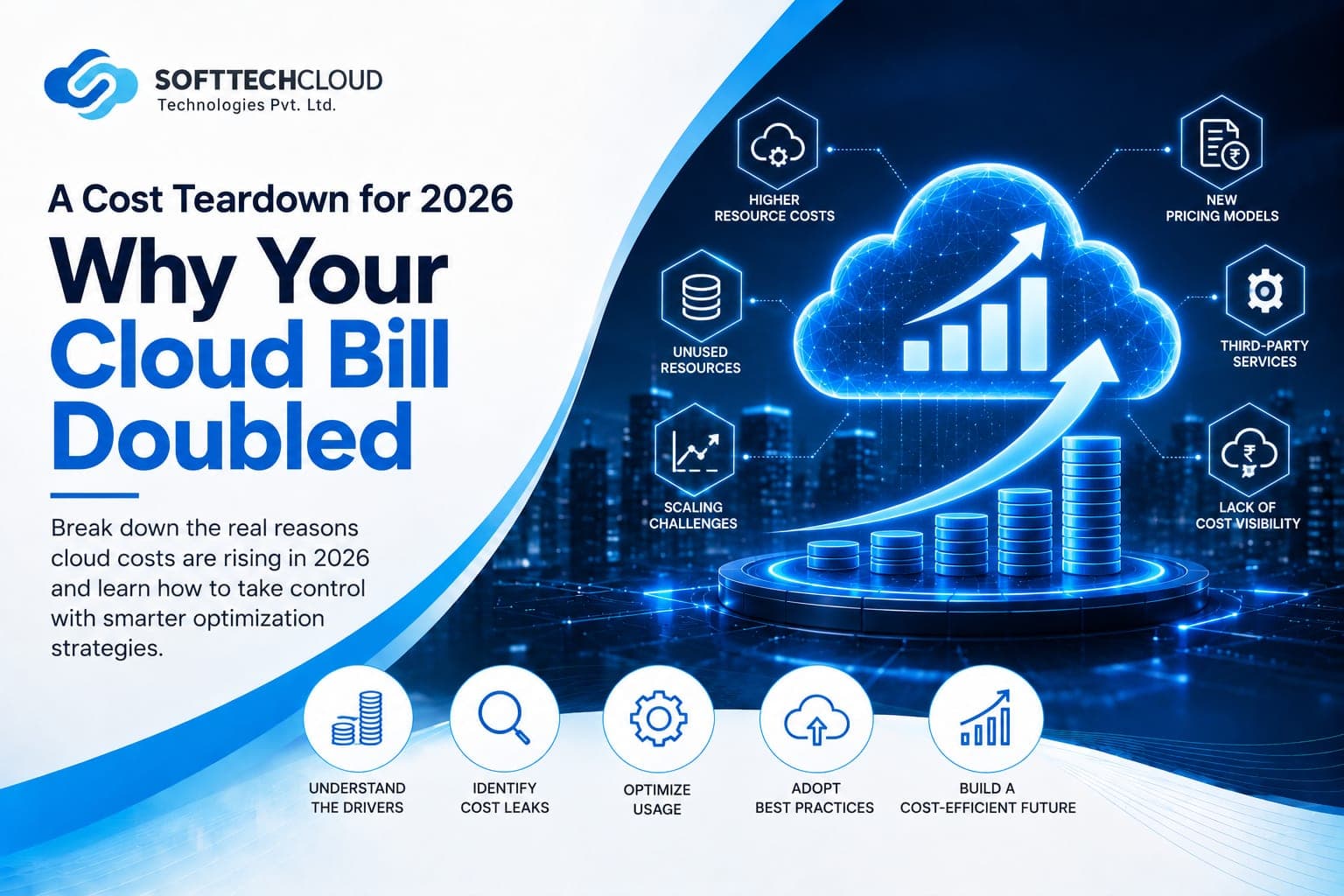
Why Your Cloud Bill Doubled in 2026: A Cost Teardown for Indian Businesses
Cloud costs rising in 2026? Here is where the money actually goes, a one week audit you can run yourself, and the fix list in order of return for Indian businesses.
Cloud bills rose sharply in 2026 for four reasons. AI inference workloads are billed per token rather than per server, idle and over-provisioned capacity has no owner, data transfer and storage charges grow silently with usage, and most Indian mid-market companies still run everything on demand while the pricing model rewards commitment. Industry benchmarks put cloud cost leakage from unoptimised infrastructure at 20% to 30%, with roughly a quarter of compute spend sitting on underutilised or idle instances. Almost all of it is recoverable without changing providers.
Cloud spend has quietly become one of the largest controllable costs in a growing Indian company, and it is usually the one nobody in the room can fully explain. The invoice arrives, it is bigger than last month, and the answer is a shrug and a note to look into it later.
This is a practical teardown of where that money actually goes. You will get a one-week audit you can run yourself with nothing more than billing console access, a fix list ordered by return rather than by difficulty, and a clear test for when the real problem is your architecture rather than your spending. No provider migration required.
Quick Stat (2026): Industry benchmarks put cloud cost leakage from unoptimised infrastructure at 20% to 30% of total spend, and roughly 25% of cloud compute spend sits on underutilised or idle instances before AI workloads are even added.
1. Why Bills Are Rising in 2026 Specifically
Three shifts landed at roughly the same time. AI moved from pilot to production, a pilot runs on a laptop and a free API tier, while production runs inference continuously, stores embeddings, retrains models and logs everything, changing the cost profile from a rounding error to a top-three line item, usually without anybody re-forecasting the budget.
Compute prices stopped falling. The steady per-unit decline that made cloud budgeting forgiving for a decade has flattened out, driven by GPU demand and power constraints, so you can no longer assume next year's hardware will be cheaper for the same workload.
Usage grew faster than governance. Most Indian mid-market companies scaled their cloud footprint far faster than they scaled anybody's responsibility for it, engineers can create infrastructure in seconds, but nobody is accountable for switching it off. The result is a bill that grows in a straight line while revenue grows in steps.
2. The Six Places Your Money Is Actually Going
In our experience auditing mid-market cloud accounts, the same six categories account for almost all recoverable spend.
- Idle and over-provisioned compute, the largest and most consistent source, including development and staging environments running around the clock for teams that work 40 hours a week, instances sized for a launch-day spike that never happened again, servers from a decommissioned project nobody switched off, and databases provisioned at production tier for an internal tool with six users.
- Storage that only ever grows, snapshots and machine images from years of deployments, log retention left at the default of forever, old backups sitting outside any retention policy, and everything on the hottest, most expensive storage tier regardless of how often it is read.
- Data transfer, the line item nobody forecasts, including egress to the internet, cross-region replication, and cross-zone chatter between services never designed to be that talkative; microservice architectures are especially prone to this since every internal call can become a billable network event.
- Managed service premiums, managed databases, queues and search are each worth paying for when they save real engineering time, but collectively can quietly cost several times the equivalent self-managed footprint, and the decision to use them is usually made once and never reviewed.
- Licensing and marketplace subscriptions, third-party tools for monitoring, security, backup and CI billed through the cloud marketplace, which renew automatically and land on the cloud bill rather than the software budget, so nobody reviews them.
- AI inference and vector storage, the new one, and the one that behaves unlike anything that came before it.
3. AI Workloads Have a Different Cost Shape
Traditional infrastructure cost scales with capacity, you provision a server and pay for it whether it is busy or not. AI inference scales with usage: you pay per token, per request, per second of GPU time. That inversion breaks three long-standing habits.
Cost per feature becomes unpredictable, since a search feature on a database costs the same whether 100 or 10,000 people use it, right up until a capacity limit, while the same feature built on a language model costs 100 times more at 100 times the volume, linearly and immediately. Prompt design becomes a cost decision, long system prompts, large retrieved context and verbose outputs are all billed, and a well-engineered prompt versus a lazy one can differ by five to ten times in cost for identical output quality. Retries and failures cost money too: a failed API call retried three times bills three times, so poor error handling in an AI feature is now directly expensive.
| Line item | What drives it |
|---|---|
| Inference tokens, input | Prompt length, retrieved context size, conversation history |
| Inference tokens, output | Response length and how verbose your instructions are |
| Embedding generation | Volume and frequency of re-indexing |
| Vector database | Index size, replicas and query volume |
| GPU compute, if self-hosting | Instance hours, almost always underutilised |
| Logging and observability | AI systems generate enormous log volume |
The practical rule is to track cost per completed task rather than cost per token, a model that costs twice as much per token but resolves the task in one call instead of four is cheaper. This is the same discipline we recommend for AI chatbot deployments, where message count and resolution rate matter far more than which model you picked.
4. Find It Yourself: A One-Week Cloud Audit
You do not need a FinOps platform to start. You need five days and access to the billing console.
- Day 1, establish the baseline, pull 12 months of spend broken down by service, and identify the top five services by cost and the top three by growth rate, since growth rate matters more than absolute size because that is where next year's problem is hiding.
- Day 2, hunt idle resources, list every compute instance, database and load balancer, pulling average CPU and memory utilisation over 30 days; anything consistently under 10% is a candidate, and anything you cannot identify an owner for is a stronger candidate.
- Day 3, audit storage, list volumes, snapshots and object storage by age and last access date, check log retention settings, and check whether anything sits on a hot tier that has not been read in 90 days.
- Day 4, trace data transfer, find your egress and cross-zone charges and identify which services generate them, usually one or two chatty integrations rather than a general problem.
- Day 5, review commitments and subscriptions, work out what percentage of your steady-state compute runs on demand versus committed, and list every marketplace subscription to confirm somebody still uses it.
The output is a single spreadsheet with each finding, the estimated monthly saving, and the effort to fix it. Sort by saving divided by effort, that ordering is your roadmap.
5. The Fix List, In Order of Return
- Shut down non-production environments outside working hours, development and staging running 12 hours on weekdays instead of continuously all week cuts their cost by roughly 65%. Automate it rather than relying on people to remember; this is typically the single largest saving available and carries the lowest risk.
- Right-size over-provisioned instances, match instance size to actual utilisation with sensible headroom, and do this after you have 30 days of utilisation data, not from memory.
- Delete orphaned resources, unattached volumes, old snapshots, idle load balancers, unused elastic IPs. Tedious, immediate and permanent.
- Apply storage lifecycle policies, move infrequently accessed objects to cooler tiers automatically, set log retention to a defined period, and expire snapshots on a schedule.
- Fix the chattiest data transfer path, usually one integration or one badly placed service; co-locating two services often removes the entire charge.
- Cache aggressively in front of AI calls, identical or near-identical queries should not hit the model twice, and for many customer-facing assistants a well-designed cache removes 30% to 50% of inference calls.
- Then, and only then, commit, see the next section for why the order matters.
Pro tip: Never commit to reserved capacity before right-sizing. Buying a three-year commitment on over-provisioned infrastructure locks in your waste for three years, it is the most common and most expensive mistake in cloud cost management, and completely avoidable by doing steps one to six first.
6. Commitments: When to Buy and When Not To
Committed use discounts are real and substantial, often 30% to 50% off on-demand rates in exchange for a one- or three-year commitment. Most Indian mid-market companies underuse them, and the ones that do use them often commit at the wrong moment.
Commit when the workload has been steady for at least three months, when you have already right-sized so you are committing to genuine need rather than habit, and when you are confident the architecture will not change materially during the term. Do not commit when you are mid-migration or mid-replatform, when the workload is seasonal or campaign-driven, when you have not completed the audit above, or when it is a GPU workload and you are still choosing models, that space moves far too fast to lock in.
A sensible split for most growing companies is to cover roughly 60% to 70% of steady baseline with commitments and leave the rest on demand for flexibility. Full coverage looks efficient on paper and turns into stranded cost the moment your architecture changes.
7. How SoftTech Cloud Technologies Helps You Cut Costs
We run cloud cost audits for growing businesses across Pune and India, and the outcome is usually the same: the bill comes down 20% to 30% without touching a single thing that customers can see.
The work starts with a full teardown of your account, service by service, identifying idle compute, orphaned storage, chatty transfer paths and AI inference cost you did not know you were carrying. From there we implement the fixes in order of return, automating non-production shutdowns, right-sizing instances, applying storage lifecycle policies and putting proper caching in front of AI calls.
Then we make it stick. Through our DevOps services we set up tagging enforcement, per-team cost reporting, budget alerts and a monthly review rhythm so the bill does not quietly grow back within two quarters. Where the underlying problem turns out to be architectural, our cloud services and data engineering teams redesign the parts that make cost scale linearly with usage.
Explore our full range of technology services, see our recent work, or talk to our experts for a free cloud cost review.
8. The Discipline That Stops the Bill Growing Back
An audit is a one-time recovery. Without discipline, the bill regrows within two quarters. Four practices prevent that.
- Tag everything and enforce it, every resource carries owner, environment and project tags, and untagged resources fail deployment; without tags, cost attribution is impossible and nobody feels responsible for anything.
- Show engineers the cost of what they build, a monthly per-team or per-service cost report changes behaviour far more reliably than any policy document, since most over-provisioning is not carelessness, it is invisibility.
- Set budgets and alerts per environment, an alert at 80% of expected monthly spend catches a runaway cost in days rather than on the invoice.
- Review monthly with a named owner, cloud cost has to belong to somebody, and in most mid-market companies it belongs to everyone, which means it belongs to no one.
This is ongoing work rather than a project with an end date, which is why we cover it alongside deployment and reliability in Cloud and DevOps: the hidden engine behind every fast-growing company.
9. When the Problem Is Architecture, Not Cost
Sometimes the bill is high because the design is wrong, and no amount of right-sizing will fix it. Signs you have an architecture problem rather than a cost problem:
- Costs scale linearly with users while revenue scales with accounts, so your unit economics get worse as you grow
- A single feature accounts for a disproportionate share of infrastructure cost
- You are paying for high availability on systems whose actual availability requirement is much lower
- You run always-on infrastructure for genuinely intermittent workloads
- Data is moved repeatedly between systems because no single system is authoritative
That last one is the most common in Indian mid-market companies, and it usually traces back to years of point-to-point integrations with no canonical data layer, optimising instance sizes on top of a bad data architecture is polishing the wrong thing. Here is the test: if a 30% increase in traffic would increase your bill by 30% or more, you have an architecture problem. Healthy systems get cheaper per unit as they scale, not more expensive.
10. What Good Looks Like: Benchmarks to Aim For
Once you have done the work, these are reasonable targets for a well-run mid-market cloud account.
| Metric | Target |
|---|---|
| Compute utilisation on production instances | 40% to 70% average, not 5% |
| Non-production environments running out of hours | Zero, unless there is a documented reason |
| Untagged resources | Under 5% of total spend |
| Steady-state compute covered by commitments | 60% to 70% |
| Storage on hot tier that has not been read in 90 days | Near zero |
| Cost per completed AI task | Known, tracked and trending down |
| Monthly cost review | Happens, with a named owner |
If you cannot currently measure most of these, that is the real finding, you cannot control a number you do not track.
11. Mistakes That Keep Cloud Bills High
- Committing before right-sizing, which locks in waste for one to three years.
- Optimising the biggest line item first instead of the fastest-growing one, growth rate tells you where next year's problem is.
- Treating cost as an engineering secret, if finance and engineering never look at the same number, nothing improves.
- Measuring cost per token or per instance instead of cost per completed task or per customer.
- Leaving logs at infinite retention, cheap per gigabyte, expensive per year.
- Assuming the provider will tell you, cost recommendation tools catch the obvious cases and miss the architectural ones.
- Doing one audit and stopping, without tagging and monthly review, the savings evaporate in two quarters.
- Migrating providers to save money, migration cost usually exceeds the saving, and the waste follows you across.
12. Final Thoughts: Cheap Is a Habit, Not a Project
Almost every business that calls us about a cloud bill wants a one-time fix. We can give them one, and it usually recovers 20% to 30%. But the companies that stay efficient are the ones that changed how they work rather than what they switched off.
Tag everything. Show engineers what their choices cost. Alert on budgets. Review monthly with somebody's name against it. None of that is technically difficult, all of it is easy to skip, which is exactly why most companies are carrying a quarter of their compute spend on servers nobody uses.
Run the five-day audit. Fix the top three findings. Then build the habit that stops it happening again.
13. Frequently Asked Questions
Most commonly because AI workloads moved from pilot to production, adding per-token inference costs, embedding generation and vector storage that did not exist in your previous baseline. Compute price declines have also flattened, and usage typically grows faster than governance.
Content & Strategy
More From The Team
A few related posts, picked from the same beat.