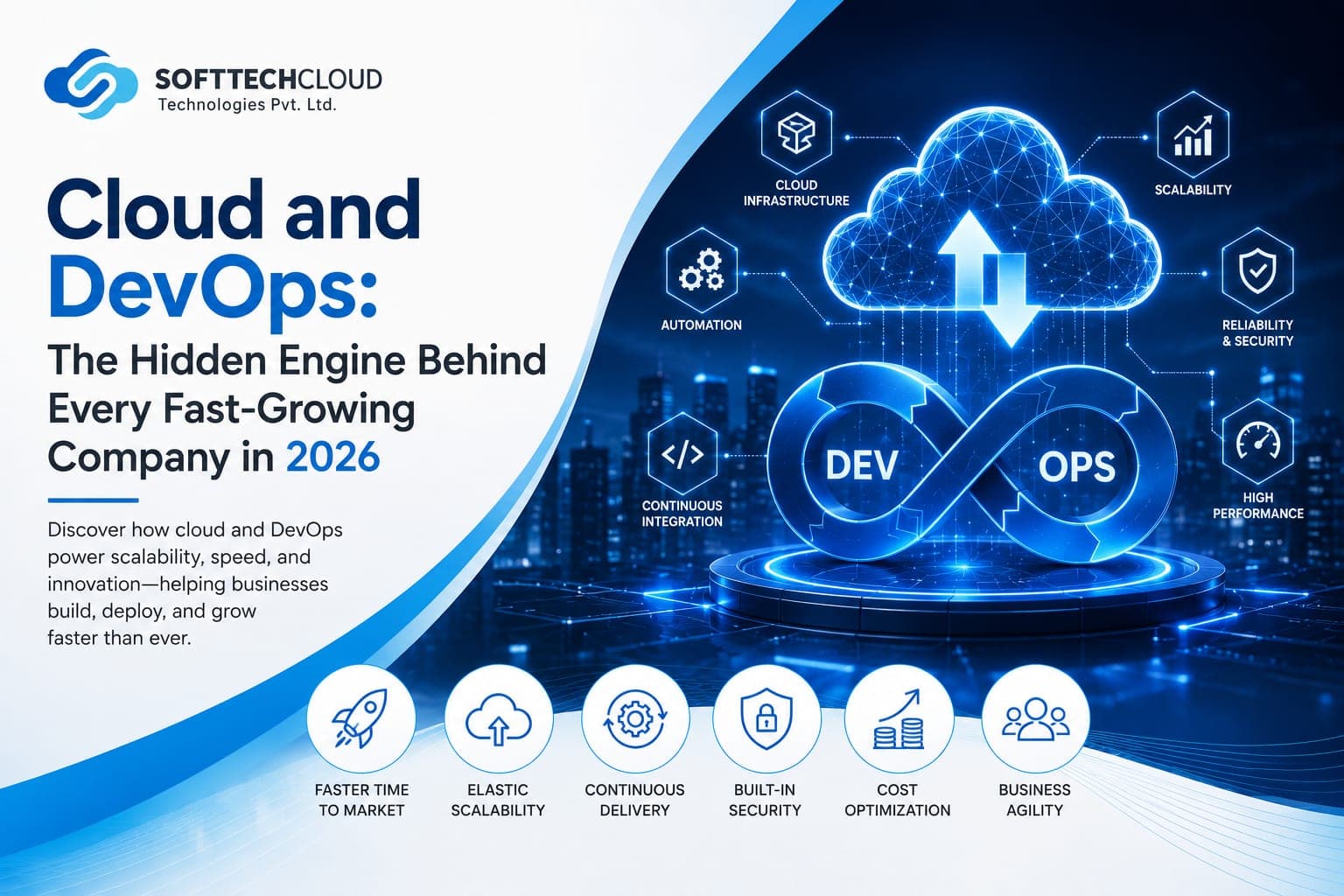
Cloud and DevOps: The Hidden Engine Behind Every Fast-Growing Company in 2026
How do cloud services and DevOps help businesses scale in 2026? A simple guide to launching faster, cutting IT costs, and growing, with real examples for Indian businesses.
Cloud computing lets businesses run software and store data over the internet instead of on their own machines, while DevOps is a modern way of building and updating that software quickly and reliably. Together, cloud and DevOps help companies launch faster, handle more customers, and cut IT costs.
Have you ever wondered how a small startup can suddenly serve millions of users overnight? The secret isn't a bigger office, it's cloud computing and DevOps, the same foundation behind the AI chatbots and automation growing businesses now run on.
Quick Stat (2026): The vast majority of fast-growing companies now run on cloud infrastructure, and teams using DevOps ship software updates many times faster than those using traditional methods.
1. What Are Cloud Services?
Traditionally, running software meant buying expensive servers and keeping them in your office. Cloud services change that: instead of owning servers, you rent computing power over the internet from providers like AWS, Azure, or Google Cloud, paying only for what you use and scaling instantly.
2. And What Exactly Is DevOps?
DevOps combines 'Development' and 'Operations': teams that traditionally worked separately. DevOps services automate the testing and release process, so new features and fixes go live in hours instead of weeks, safely and reliably.
3. Why Cloud + DevOps Are Better Together
- Speed: ship updates many times faster.
- Scale: handle 10 or 10 million customers automatically.
- Lower cost: pay only for what you use.
- Reliability: automated testing means fewer bugs and less downtime.
- Smarter decisions: pair with data engineering for real-time insight.
4. Traditional IT vs Cloud + DevOps
| Factor | Traditional IT | Cloud + DevOps |
|---|---|---|
| Upfront cost | High (buy servers) | Low (pay monthly) |
| Scaling up | Slow, buy hardware | Instant, automatic |
| Software updates | Weeks, risky | Hours, safe |
| Downtime | Frequent | Rare |
| Maintenance | Your burden | Managed for you |
5. A Real-World Example Every Business Can Relate To
Imagine an online store where a festival sale sends traffic through the roof. With cloud services and DevOps in place, systems automatically add power to handle the rush, and resources scale back down once the sale ends, reliability during the peak and savings during the quiet.
6. Common Misconceptions
'The cloud is expensive': set up correctly, it's usually cheaper than owning servers. 'The cloud isn't secure': leading providers offer stronger security than most in-house setups. 'Migration is too risky': with an experienced partner, migration is planned, tested, and done with zero data loss.
7. How to Move to Cloud + DevOps, Step by Step
- Assess your current systems and identify what's slow, costly, or fragile.
- Choose the right cloud platform for your needs and budget.
- Migrate in phases, starting with one system.
- Set up DevOps automation for testing and releases.
- Add monitoring and data pipelines for visibility.
- Integrate business tools like Salesforce CRM so everything works together.
8. How SoftTech Cloud Technologies Powers Your Growth
We help businesses adopt cloud and DevOps safely and affordably, moving in careful phases so your business never skips a beat. Browse our full services or talk to our team to plan your move.
9. How to Keep Cloud Costs Under Control
- Right-size resources to pay for what you actually use.
- Use auto-scaling to add power during peaks and remove it when quiet.
- Turn off idle development and test environments.
- Monitor spending with dashboards to spot waste early.
10. Choosing Between AWS, Azure, and Google Cloud
| Platform | Often chosen for |
|---|---|
| AWS | Widest range of services, great for scaling startups |
| Microsoft Azure | Businesses already using Microsoft & enterprise tools |
| Google Cloud | Strong data, analytics, and AI/ML workloads |
11. Cloud & DevOps for Different Business Types
- Startups: launch fast and scale without buying servers.
- E-commerce: handle traffic spikes during sales without crashing.
- SaaS products: ship features weekly with DevOps automation.
- Traditional businesses: cut IT costs and modernise safely.
- Data-heavy businesses: combine cloud with data engineering.
12. Signs Your Business Has Outgrown Its Current Setup
- Your website slows down or crashes during busy periods.
- IT costs keep rising but performance doesn't improve.
- Updates take weeks and often break something.
- Your data is scattered with no single view.
- You can't scale quickly when a big opportunity appears.
13. Cloud Security & Reliability: Better Than You Think
Leading cloud services providers invest more in security than almost any single business could, encryption, automatic backups, and 99.9%+ uptime, paired with good DevOps practices.
14. The Real, Long-Term Savings of Cloud + DevOps
| Saving | How it happens |
|---|---|
| No hardware cost | Rent instead of buying servers |
| Less downtime | Automated, tested releases |
| Lower staff burden | Provider handles maintenance |
| Faster launches | Ship features in hours, not weeks |
| Pay for actual use | Scale down in quiet periods |
15. The Future: Where Cloud & DevOps Are Heading
Three shifts to watch: AI-assisted DevOps helping write and test code faster, serverless computing running code without managing any servers, and tighter integration with data and AI through data engineering and Salesforce systems.
16. Final Thoughts: Build the Engine Before You Need It
Cloud and DevOps are the foundation that decides how fast your business can grow. Companies that build this engine early can seize opportunities instantly.
17. Frequently Asked Questions
Cloud is where your software and data live (rented computing power over the internet). DevOps is how you build and update that software quickly and reliably. They work best together.
SoftTech Cloud Team
Content & Strategy
More From The Team
A few related posts, picked from the same beat.