Meta Andromeda Update: What Changed in November 2026 and What Advertisers Should Do
Meta's next-generation Andromeda ads retrieval system is live. Here is what changed, what Meta's numbers actually measure, and what advertisers should check before they blame the update.
Key takeaways
- As of November 2026, the latest Meta Andromeda update is the next-generation system Meta described on 28 October 2026. Meta says it runs in production.
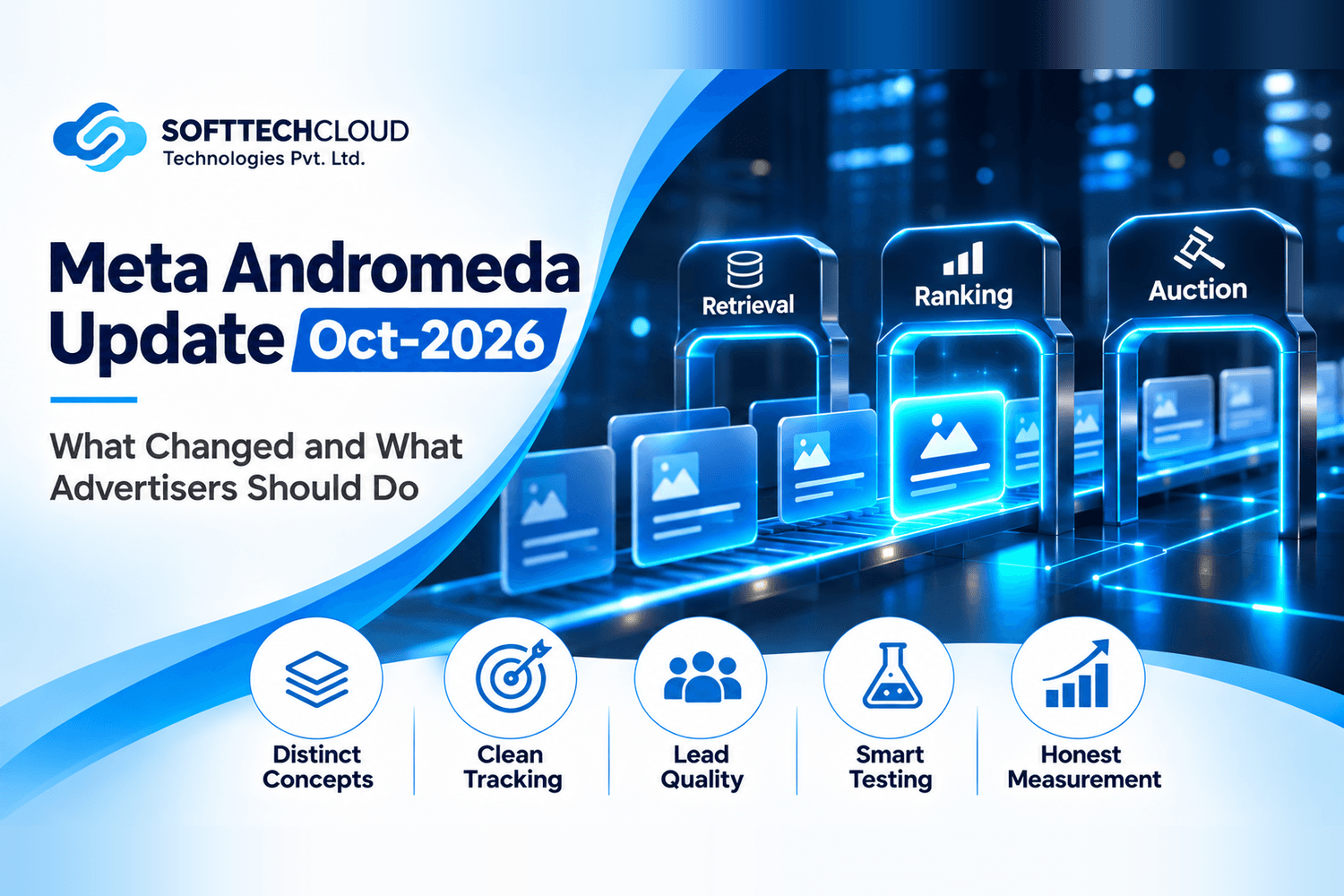
- Andromeda is the retrieval stage. It shortlists ads before ranking and the auction.
- Meta's numbers (1B+ ads per second, ~100x, ~300x fewer FLOPs, +2.4% Facebook conversions) measure different things. Read each one with its scope.
- No new setting or opt-in is described. Focus on distinct creative concepts, clean conversion tracking and lead quality.
If your Meta cost per lead moved last month, someone on your team has probably blamed the Meta Andromeda update. It is the explanation most people reach for first, and it is often only half right.
Meta did publish a major technical update on 28 October 2026. But the name is confusing, the numbers are easy to misread, and much of what is written goes further than Meta did. In our day-to-day performance marketing work, the first thing we do with any platform change is separate what the platform said from what people are saying about it. This post does the same. Where Meta has spoken, we quote Meta. Where we give our own advice, we label it.
What is the latest Meta Andromeda update?
As of November 2026, the latest update is the next generation of Meta's ads retrieval system, which Meta described in its engineering post on 28 October 2026. Meta says the system is already in production. Meta has not announced a separate November update, and it has not given advertisers a rollout date.
What is Meta Andromeda?
Meta Andromeda is Meta's machine learning system for personalised ads retrieval. It is the first stage of ad delivery. It takes a very large pool of eligible ads and narrows it to a short list of strong candidates, in milliseconds. A ranking stage then scores those candidates in detail, and the auction decides which ad is shown.
Is it "Andromeda 2.0"?
Meta's post is titled "Meta Andromeda: Powering the Next Generation of Ads Retrieval Through Model-System Co-Design." Inside, Meta calls the system "the next generation of Meta Andromeda," "the latest iteration," and "the 2026 Meta Andromeda." The phrase "2.0" does not appear.
So "Andromeda 2.0" is shorthand, not Meta's product name. There is no separate Andromeda 2.0 product, no launch date for advertisers, and no setting to switch on.
What does Andromeda do, in plain words?
Think of ad delivery as three gates:
| Stage | Who handles it | What it does |
|---|---|---|
| 1. Retrieval | Andromeda | Narrows millions of eligible ads to a short list of strong candidates |
| 2. Ranking | Ranking models | Scores the short list in finer detail |
| 3. Auction and delivery | Auction system | Picks the ad that is actually shown |
An ad that does not pass retrieval never reaches ranking or the auction. A higher bid or a better-looking creative cannot rescue it at that stage. That is why retrieval deserves attention from anyone running paid campaigns.
How we got here: the timeline
- 2 December 2024: Meta launches Andromeda as the retrieval engine behind Advantage+ automation.
- 28 January 2026: reported by secondary sources, not verified in Meta's primary post: Andromeda runs on Nvidia, AMD and MTIA chips.
- 29 July 2026: reported on the Q2 earnings call: the first generative model is deployed in ads retrieval.
- 21 October 2026: Q3 earnings call: Meta credits Andromeda with a +1.4% Facebook conversion increase.
- 28 October 2026: Meta publishes the next-generation Andromeda engineering post. This is the primary source for this article.
Why did Meta rebuild it?
Meta gives two reasons in its post.
The first is volume. Generative AI tools have helped advertisers create "hundreds of millions of new ads." The pool of eligible ads per request grew faster than the 2024 system could score it within the time budget.
The second is that ranking improved so much that retrieval became the bottleneck. A strong ranking model cannot do much if the right ad never makes the short list.
What changed in the 2026 version?
A Mixture-of-Experts model. The 2024 system scored ads with a single deep neural network. The 2026 version uses an ensemble of specialised user "experts." A gating network sends each candidate to the most relevant experts. Meta says this brings retrieval close to ranking-level quality, at about 300x fewer inference-time FLOPs than its 2024 retrieval model.
One GPU server for the whole pipeline. Earlier, index matching, scoring and top-K selection ran across different machines, which meant moving a lot of data over the network. Now all three run on one GPU server. Meta reports roughly 100x less network traffic.
A fused GPU kernel. Embedding lookup, the interaction model and scoring run as a single kernel, so intermediate results stay on the chip. Meta built this work with NVIDIA.
Two more points, so you do not overstate them. Meta describes INT8 quantisation as giving "a further up to 2x throughput increase over the optimized FP16 kernels." Meta presents this as headroom, not as the source of the headline numbers. And Meta says it is still extending this work to Grace Blackwell. That is ongoing work, not a shipped upgrade.
How do I read Meta's numbers?
Each number measures something different, so do not merge them into one headline like "Andromeda is 300 times faster."
| Meta's number | What it measures | What it does not measure |
|---|---|---|
| 1 billion+ ads per second | Retrieval throughput on one GPU server, in production | How many ads a user sees, or your delivery speed |
| ~100x | Compared with the 2024 figure of "tens of millions per GPU card" | A like-for-like comparison. The units differ (per card vs per server) |
| ~300x fewer FLOPs | Compute needed for model inference | Your cost per result or ROI |
| 10 billion+ ads per second | The fused gating kernel on a single GH200 chip | End-to-end pipeline speed |
| ~100x less network traffic | The infrastructure effect of co-location | Advertiser results |
| +2.4% Facebook conversions | Meta's claim, "since 2025" | The method, a baseline, or any Instagram figure |
A note on the 2.4%. It covers the period since 2025, so it may reflect both the 2024 system and the 2026 update together. Read it as Meta's platform-level claim, not a promise for your account. Meta has not described how it measured the effect.
Did Meta turn Andromeda on for my account?
Meta's post describes no setting, opt-in or new campaign type. Your Ads Manager does not show an Andromeda switch. The system works behind the scenes on every eligible ad. The more useful question is what changed in your campaigns.
Do I need more creatives now?
Meta has not published a creative count. The more useful question is whether your creatives are distinct. If retrieval scores every eligible ad, ten colour variants of one message are not ten meaningfully different options.
Our advice is to test concepts built around different problems, proof points, demos, offers and trust signals. This is our testing approach, not official Meta guidance.
| Concept | Example hook | Proof or content |
|---|---|---|
| Problem | Your website loses enquiries before anyone calls. | Show the friction: slow page, confusing navigation |
| Demo | See how a CRM cuts follow-up time. | Show a real workflow |
| Proof | Here is what one client's pipeline looked like. | A verifiable case study, with permission |
| Offer | Book a free website review. | State scope, eligibility and what the prospect gets |
| Trust | A partner from planning to launch. | Team, process and support model |
If you want help building that library, our digital marketing team can plan it. Our earlier post on performance marketing and ad spend covers how to budget for testing.
Does Andromeda replace audience targeting?
Meta says index matching enforces advertiser targeting rules, so targeting still applies. Meta's post does not say that targeting is no longer useful, and it does not say that broad targeting always wins. Test broad and interest-led approaches against your own business results.
Why look past cost per lead?
The most common mistake in lead ads is judging by cost per lead alone. A cheap lead is not always a useful one. This example is illustrative, not real campaign data:
| Metric | Campaign A | Campaign B |
|---|---|---|
| Leads | 100 | 60 |
| Qualified leads | 10 | 30 |
| Spend | ₹10,000 | ₹9,000 |
| Cost per lead | ₹100 | ₹150 |
| Cost per qualified lead | ₹1,000 | ₹300 |
Campaign A looks cheaper if you read only the lead cost. Campaign B produces three times as many qualified leads, at a much lower cost per qualified lead. Track qualified leads, appointments and sales in your CRM, then compare campaigns on those. If your leads sit in spreadsheets, our CRM development team can build the pipeline. Our real estate CRM guide explains what a lead record should capture.
Speed also matters. A lead that waits two days for a reply is often lost to the competitor who replied in an hour. An AI chat bot can handle first replies and basic qualification, so your sales team gets warmer leads.
Which Andromeda claims are wrong?
| Claim you may have read | What Meta's post says | Verdict |
|---|---|---|
| Andromeda replaced the auction with deep learning | Andromeda is the retrieval stage. The auction is separate | Not accurate |
| Near-identical ads are bundled under one Entity ID | Meta's post does not mention Entity IDs | Not verified |
| Andromeda runs in 300 milliseconds | Meta says "milliseconds." The 300x figure refers to compute | Not accurate |
| You must enable Andromeda 2.0 | No setting or opt-in is described | Not accurate |
| Interest targeting is dead | Targeting rules are still enforced in index matching | Not accurate |
| Every advertiser gets 2.4% more conversions | Meta reports a platform-level figure, not a guarantee | Not accurate |
| Raise your budget by 15-20% a day | Meta gave no such figure | Not from Meta |
What we still do not know
- How results vary by industry, budget, objective and account age. Meta has not published this.
- The full method and baseline behind the 2.4% figure.
- Any Instagram-specific figure for the same claim.
- Whether there is an official creative count per ad set.
- When the Grace Blackwell work will reach production.
If your results dropped, check these first
Before you blame the update, check these in order. This is our diagnostic approach, not a Meta checklist.
- Did the creative change? Look at a new concept, or only a colour or text tweak, over the last two to three weeks.
- Did the offer, price or landing page change? A campaign cannot outperform its landing page. Slow or confusing website pages often look like ad problems.
- Is tracking intact? Check Pixel and Conversions API events, and confirm deduplication. Broken tracking produces numbers that look like performance changes.
- Did spend or seasonality shift? A big budget change can reset learning. A festival or a slow month can look like a platform problem.
- Are you measuring qualified leads? If cost per lead is stable but sales are falling, the problem may be lead quality, not delivery.
If the gap remains, run a controlled test. Change one variable at a time, keep the conversion event the same, and give it enough time and volume to read clearly. Our data engineering team can help if your lead and sales data lives in too many places to compare. Our post on why AI projects fail without clean data makes the same point: the system is only as good as the data behind it.
GEM and GenRecs: the other Meta systems
Andromeda is one part of a larger stack. Meta also published posts on GEM, its generative ads model, and GenRecs Tokenization, both in October 2026. Their roles are different:
- Andromeda shortlists candidate ads. This is retrieval.
- GEM is a central model used for ranking and prediction.
- GenRecs represents ads, products and pages as semantic tokens, which helps with new items.
Each has its own results. Do not assign GEM's or GenRecs' numbers to Andromeda. For those figures, read Meta's original posts.
Mistakes we see after the hype
- Rebuilding campaigns for a name. Meta has not published a migration path. Rebuilding an account because of a label is an expensive reaction.
- Adding creative volume without new concepts. Fifty variants of one idea are still one idea.
- Reading one day's numbers. Learning phases and daily swings look dramatic. Judge on a full week or more.
- Ignoring organic search. Paid and organic reinforce each other. If you are not sure how your landing pages rank, a review of your SEO setup is a sensible start.
- Treating a platform average as your guarantee. Meta's figures are averages across its platform.
Final thoughts
Andromeda is a serious engineering change. Meta is scoring far more ads per second, using a more expressive model, on tighter hardware. For advertisers, that raises the value of distinct ideas, clean conversion data and honest measurement.
It does not give you a new setting to pull, and it does not explain every swing in your account. The useful response is to tighten your creative, tracking and lead quality, then measure the result. The advertisers who do well are not the ones who rebuild fastest. They are the ones who test best.
Frequently asked questions
As of November 2026, it is the next generation of Meta's ads retrieval system, described by Meta on 28 October 2026. Meta says it is in production. Meta has not announced a separate November update.
Meta Andromeda is the machine learning system that shortlists eligible ads for retrieval, before ranking and the auction.
The system is real and described in Meta's engineering post. The "2.0" label is not Meta's official product name.
Meta's post describes no setting, opt-in or new campaign type.
Meta says targeting rules are still enforced in matching. Test broad and interest-led approaches against your own results.
Meta has not published a number. Focus on distinct concepts rather than total count.
Possibly, but check creative changes, offer changes, tracking and seasonality first. Meta's post does not say the update changes costs for any specific account.
Andromeda handles retrieval, which shortlists ads. GEM is used for ranking and prediction.
Want an honest review of your Meta campaigns?
If your Meta results have moved and you cannot tell why, our PPC team can look at creative concepts, tracking setup and lead quality, and tell you what we see before you decide anything. Contact us here.
Related reading: Performance Marketing 2026: Turn Ad Spend into Growth | Real Estate CRM in India: Features & Buying Guide 2026 | DPDP Act Compliance Checklist for Websites | Why Most AI Projects Fail in Indian Companies
Sources
- Engineering at Meta, "Meta Andromeda: Powering the Next Generation of Ads Retrieval Through Model-System Co-Design", 28 October 2026: https://engineering.fb.com/2026/10/28/ml-applications/meta-andromeda-next-gen-ads-retrieval-gpu-co-design/
- Engineering at Meta, "Meta Andromeda: Supercharging Advantage+ automation with the next-gen personalized ads retrieval engine", 2 December 2024: https://engineering.fb.com/2024/12/02/production-engineering/meta-andromeda-advantage-automation-next-gen-personalized-ads-retrieval-engine/
PPC Specialist
More From The Team
A few related posts, picked from the same beat.