
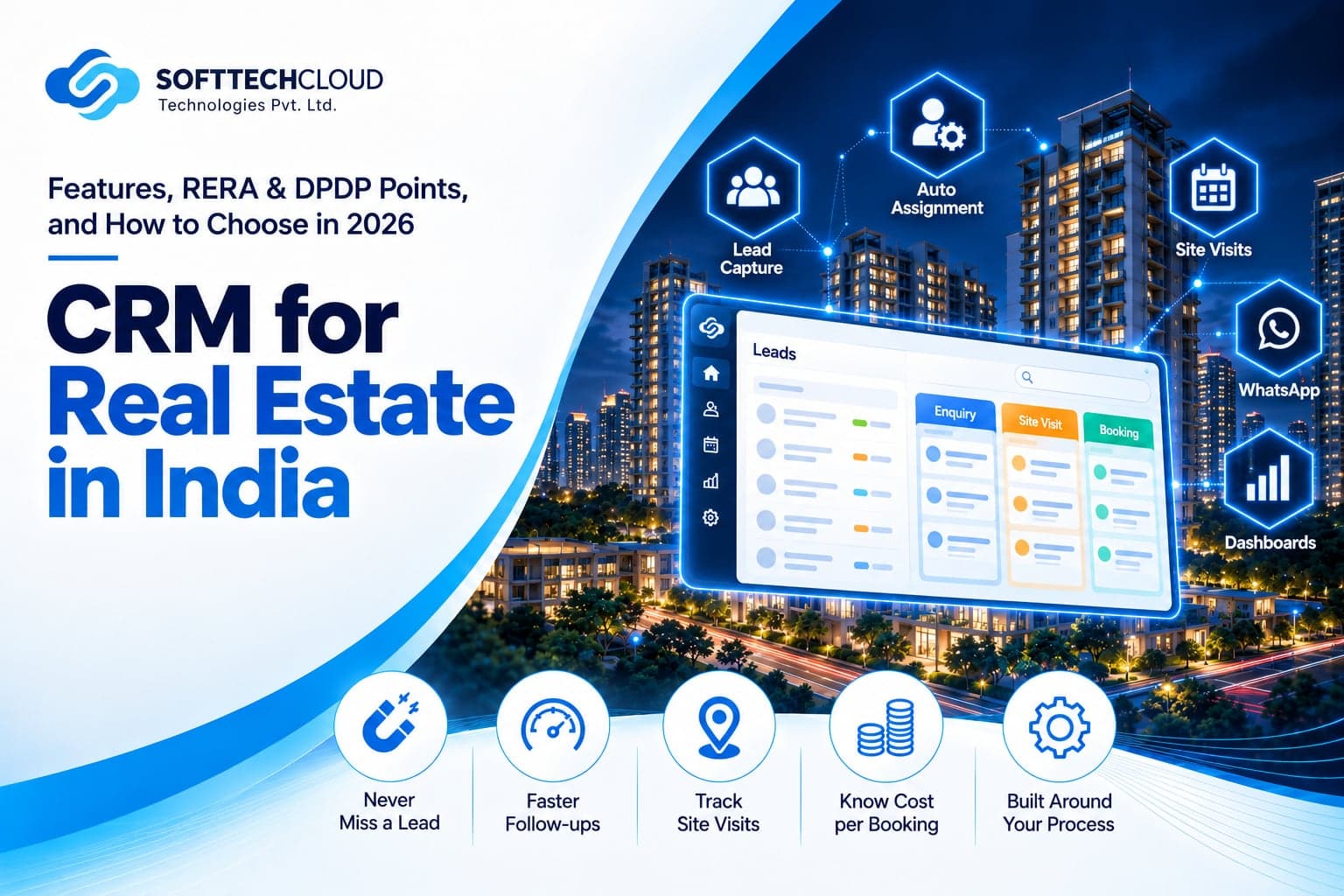
CRM for Real Estate in India: Features, RERA and DPDP Points, and How to Choose in 2026
A real estate CRM should capture every enquiry, assign it in seconds, track site visits and show cost per booking. Here is what to look for, what to avoid, and why a custom-built CRM often fits Indian developers better.
A real estate CRM is software that captures every property enquiry in one place, assigns it to a sales executive within seconds, schedules and tracks site visits, and shows management which campaigns produce bookings, not just leads. For Indian builders, developers and channel partners, the best CRM is the one that matches your actual sales process, which is why many choose a custom-built system over a generic tool.
Most developers do not have a demand problem. They have a lead management problem: enquiries arriving from portals, Google and Meta ads, hoardings, channel partners and walk-ins, then living in WhatsApp chats and Excel sheets until they go cold. This guide explains what a real estate CRM should do, the RERA and DPDP points to keep in mind, how to judge ready-made versus custom, and how to start without a big-bang project.
This guide covers what a real estate CRM should do at each stage of the buyer journey, the features that change sales outcomes, where AI genuinely helps, the RERA and data-protection points to respect, and how to decide between ready-made and custom. It is written for sales heads, directors and marketing managers at developers and channel partner firms, not for IT teams.
Quick Stat: A Harvard Business Review study of more than a million web-generated sales leads (Oldroyd, McElheran and Elkington, 2011) found that companies responding within an hour were nearly seven times as likely to qualify the lead as those responding even an hour later. The data is US-based and dated, but the direction is consistent with what property sales teams see every day.
1. What a Real Estate CRM Actually Does
A generic CRM tracks contacts and deals. A real estate CRM tracks a longer, more specific journey: enquiry, qualification, site visit, negotiation, booking, payment milestones and handover, often across several projects and several sales channels at once.
| Stage | What happens | What the CRM should handle |
|---|---|---|
| Enquiry | Lead arrives from ads, portals, website, partner or walk-in | Capture from every source, tag the source and project, detect duplicates |
| Assignment | Someone has to call the buyer | Automatic assignment by project, location, language or workload, with an alert |
| Qualification | Budget, configuration, timeline, funding | A structured form or AI-assisted questions, so every executive records the same things |
| Site visit | Buyer is invited, visits, may revisit | Scheduling, reminders, check-in, visit feedback, repeat-visit history |
| Negotiation and booking | Unit selection, quotation, token | Unit and inventory view, quotation records, approval trail |
| Post-booking | Payment milestones, documents, handover | Reminders, document tracking, one customer record from enquiry to handover |
2. Why Response Speed Matters More Than Another Ad Campaign
The Harvard Business Review study quoted at the top of this guide measured how quickly companies contacted web-generated leads and how often those leads went on to qualify. The point for a property developer is simple: the minutes after an enquiry arrives are worth more than the days after it.
Two honest caveats. The data is from US companies and is over a decade old, so do not read it as a promise for Indian property buyers, and treat the exact multiples as indicative. But the direction matches what every sales head in real estate already knows: a buyer who enquires about three projects usually talks to whoever calls first. A CRM that assigns and alerts instantly, and reminds the executive when a follow-up is late, is a direct fix for that.
3. Must-Have Features for Indian Developers
Not every feature matters equally. These are the ones that change sales outcomes:
- Multi-source lead capture: Google Ads, Meta lead forms, property portals, your website and landing pages, WhatsApp, calls and walk-ins, all landing in one system.
- Duplicate detection: the same buyer enquiring through three channels should become one record, not three leads and three cost-per-lead entries.
- Automatic assignment rules: by project, location, language, executive availability or round-robin, with escalation if no one acts.
- Follow-up reminders and a visible pipeline, so no lead depends on someone's memory.
- Site visit scheduling and tracking: who was invited, who came, who came twice, who never showed up.
- Inventory and unit availability, so executives quote only what is actually available.
- Channel partner management: partner onboarding, lead ownership, and a clear record of who brought which buyer, so commission disputes do not start.
- WhatsApp integration: send project details the moment an enquiry lands and keep conversations attached to the lead record.
- Management dashboards: leads by source, enquiry-to-visit and visit-to-booking ratios, cost per lead and, more importantly, cost per booking.
- Role-based access: sales executives see their leads, managers see their team, management sees everything, and exports are controlled.
The most useful number a CRM gives a developer is cost per booking by source. Cost per lead tells you what a click cost. Cost per booking tells you which channel actually sells units, and it is the number that should decide your next ad budget.
4. Where AI Genuinely Helps (and Where It Does Not)
AI is useful in a real estate CRM when it is pointed at narrow, repetitive jobs:
- Instant first response: answering common questions about configuration, location, possession timeline and amenities at any hour, then handing over to a human.
- Lead qualification: collecting budget, timeline and preferred configuration through conversation, so executives call the warm leads first.
- Follow-up drafting: suggesting the next message based on the lead's stage and history.
- Summaries: giving a manager a quick view of a lead's history before a call.
AI is not a substitute for a salesperson on price discussions, negotiation or trust-building, and it should never state anything about approvals, possession dates or pricing that is not in your approved content. Keep the answers it can give limited to information you have verified, and keep a clear handover to a human. We cover the general discipline in our guide on why AI projects fail without clean data and the build side in our AI chatbot development work.
5. RERA and Data Protection Points to Keep in Mind
Property marketing in India carries two compliance threads that a CRM and its connected tools should respect. This is general information, not legal advice, so confirm specifics with your legal adviser.
- RERA advertising: under the Real Estate (Regulation and Development) Act, 2016, a registered project is expected to show its RERA registration number in advertisements and promotional material, and the promoter is responsible for the accuracy of what is advertised. In Maharashtra, MahaRERA publishes the rules and orders that apply. Keep your landing pages, chatbot answers and WhatsApp templates consistent with the registered project details.
- Personal data: a CRM stores names, phone numbers, email addresses, budgets and sometimes documents. India's Digital Personal Data Protection Act, 2023 expects clear notice, valid consent for the purpose, reasonable security and a way to handle correction and erasure requests. Our DPDP compliance checklist walks through the website and forms side of this.
- Messaging consent: if you message buyers on WhatsApp, use approved templates and record opt-in. WhatsApp business messaging rules changed recently, and we explain them in our WhatsApp Business API pricing guide.
- Access control and audit: restrict who can export the buyer list, and log it. A leaked buyer database from a sales team member is one of the most common real-world data problems for developers.
6. Ready-Made CRM or Custom-Built: How to Decide
Both can work. The right choice depends on how standard your sales process is.
| Question | Ready-made CRM tends to fit when | Custom-built CRM tends to fit when |
|---|---|---|
| Sales process | It follows a standard lead-to-deal pipeline | You have project-wise stages, channel partners, site-visit workflows or approval chains of your own |
| Number of projects | One or two simple projects | Multiple projects, townships or phases with different teams |
| Integrations | Common tools with ready connectors | Your ad accounts, WhatsApp, telephony, ERP or accounts software need to work together in a specific way |
| Reporting | Standard dashboards are enough | Management wants cost per booking, partner performance or inventory-linked views |
| Ownership | You are comfortable with a subscription and the vendor's roadmap | You want to own the workflow and change it as your sales process changes |
| Data control | Vendor hosting is acceptable | You want hosting, access control and data location decided by you |
A common middle path is to start with the core of a custom CRM, covering lead capture, assignment, follow-ups, site visits and one management dashboard, then add modules such as channel partner portal, inventory and WhatsApp automation as the team adopts it. This keeps the first release small enough for the team to actually use. Our CRM development work is usually scoped this way.
7. How a Custom Real Estate CRM Is Scoped
A custom CRM does not have a fixed price list, because it depends on what you need. We discuss requirements first and then quote against a written scope. These are the factors that shape that scope:
- Number of users and roles: sales executives, team leads, managers, channel partners, management.
- Number of projects and how different their workflows are.
- Lead sources and integrations: ad platforms, portals, website forms, WhatsApp, telephony.
- Modules required: lead management, site visits, inventory, quotations, partner portal, payment reminders, documents.
- Dashboards and reports: what management wants to see and how often.
- AI features: chatbot, qualification, follow-up suggestions.
- Hosting, security and data-protection requirements.
- Support and training after launch.
The advantage of custom is that you decide which of these matter. You can start with the modules that fix your biggest leak and add the rest later.
8. How SoftTech Cloud Technologies Helps You Build It
We build custom CRMs and connect them to the rest of the sales stack for developers, builders and channel partners across Maharashtra. That covers CRM development, AI chatbots for instant enquiry response, landing pages and performance marketing that feed the CRM, and dashboards for management. You can see how we approach property businesses on our real estate page, explore our portfolio, or talk to our team for a requirements discussion.
9. The Numbers Worth Tracking Every Week
A CRM is only useful if someone looks at what it says. These are the measures that tell a sales head whether the process is working. We list what each one tells you, because the targets depend on your project, your price band and your market, and should be set from your own data rather than copied from a benchmark.
| Measure | What it tells you | Where it usually points |
|---|---|---|
| First response time | How long a new enquiry waits before someone contacts the buyer | Weak assignment rules, no alerts, or too few executives on a campaign |
| Enquiry-to-site-visit ratio | How many enquiries become a scheduled and completed visit | Lead quality, call quality, or slow follow-up |
| Visit-to-booking ratio | How many visits end in a booking | Pricing, inventory, negotiation process or visit experience |
| Follow-up overdue count | How many leads have a missed or late follow-up | Reminder discipline and workload per executive |
| Cost per booking, by source | What each channel really costs to produce a sale | Where to move the ad budget next |
| Channel partner contribution | Which partners bring leads that actually book | Partner onboarding, ownership rules and commission disputes |
Pro tip: review these six numbers in a fixed weekly meeting, by project, using the CRM dashboard and not a separate Excel sheet. The habit of looking at them together does more for the sales process than any single feature.
10. Mistakes Developers Make With CRM Projects
- Buying features before fixing the process. A CRM makes a clear sales process faster, and it makes a messy one visible. Write down your lead-to-booking stages first.
- No single owner. Someone senior must own adoption, or the sales team will go back to Excel and WhatsApp.
- Too many mandatory fields. If entering a lead takes three minutes, executives will skip it. Capture the essentials and enrich later.
- Ignoring channel partners. If partner leads sit outside the CRM, your numbers will always be incomplete.
- Measuring leads instead of bookings. Cost per booking, by source, is the number that matters.
- Skipping data protection. Buyer data needs access control and consent records from day one.
- Trying to launch everything at once. Start with capture, assignment, follow-up and visits, then expand.
11. A Practical 60-Day Rollout Plan
- Days 1 to 10: Map the process. Write down every stage from enquiry to handover, who owns it, and where leads currently get lost.
- Days 11 to 20: Define the core scope. Lead sources, assignment rules, follow-up rules, site visit workflow and the five numbers management wants to see.
- Days 21 to 40: Build and connect. Lead capture from ads, website and WhatsApp, assignment, reminders and the first dashboard. Test with real leads from one project.
- Days 41 to 50: Train and run in parallel. Executives use the CRM while the old sheet is still available, so gaps surface safely.
- Days 51 to 60: Review and extend. Check response time, follow-up discipline and visit conversion. Then decide the next module.
12. Final Thoughts: Fix the Follow-Up Before You Buy More Leads
Most developers can generate more enquiries by spending more. Far fewer can say what happens to each enquiry in the first hour, how many reach a site visit, or which channel really sells units. A CRM does not create demand. It makes sure the demand you already pay for is answered quickly, followed up properly and measured honestly.
Start small. Capture every lead in one place, assign it automatically, remind people to follow up, track visits, and look at five numbers every week. Add modules only when the team is using the core. A custom CRM is worth building when it matches how your sales team actually works, and it should grow at the pace they adopt it.
13. Frequently Asked Questions
A real estate CRM is software that captures property enquiries from every source, assigns them to sales executives, tracks follow-ups and site visits, and reports which campaigns and channel partners produce bookings. It follows the buyer from enquiry through booking and handover.
IT & Marketing Head
More From The Team
A few related posts, picked from the same beat.