ANI vs AGI vs ASI: Clear Differences Explained for 2026
ANI is every AI in use today, AGI is human-level ability across almost any thinking task, and ASI is far beyond humans. Here is where AI really stands in 2026, what the benchmarks show, and what Indian businesses should do now.
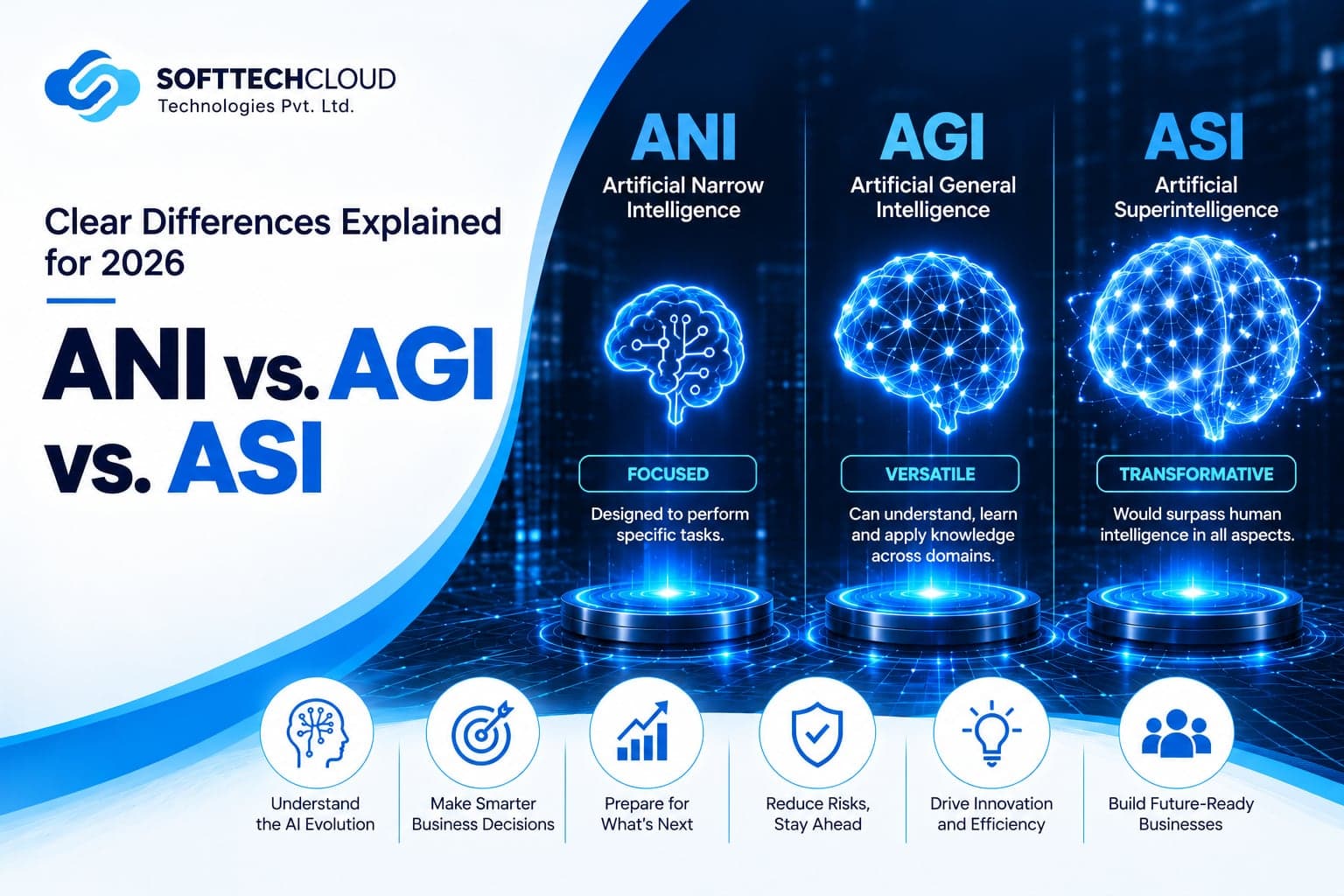
ANI (Artificial Narrow Intelligence) is every AI system in commercial use today. It is excellent at one task and cannot transfer that skill elsewhere. AGI (Artificial General Intelligence) is human-level ability across almost any thinking task, and it has not been built yet. ASI (Artificial Superintelligence) is intelligence far beyond the best humans, and it remains theoretical.
Almost every AI headline you have read this year is really an argument about these three letters. Some people say AGI is already here. Others say it is decades away. Both groups are quoting real experts, and both are using the same word to mean different things. No wonder business owners are confused.
This guide clears it up in plain language. You will learn what ANI, AGI and ASI mean, where the technology genuinely stands in 2026, what the benchmarks and expert timelines actually say, and what a growing Indian business should do about it this quarter. No hype, no doom, just a clear picture and a practical plan.
Quick Stat (2026): Deloitte's State of AI in the Enterprise 2026 report finds that about 40% of Indian respondents report significant or full AI usage, against a global average of about 28%. The gap is no longer access to AI. It is execution.
1. ANI vs AGI vs ASI: The Simple Difference
The three terms describe how general an AI is, not how powerful. A chess engine beats every human alive at chess and is still ANI, because it cannot do anything else.
| ANI (Narrow) | AGI (General) | ASI (Super) | |
|---|---|---|---|
| What it is | Every AI in use today. Excellent at one task or a narrow group of tasks. | Human-level ability across essentially any thinking task. | Intelligence far beyond the best humans in nearly every field. |
| Status in 2026 | Deployed everywhere, commercially mature | Not achieved. The definition itself is still argued about | Not achieved. Still theoretical |
| Examples | Chatbots, image generators, recommendation engines, fraud detection, translation, coding assistants | None yet | None yet |
| Main limitation | Cannot transfer skill outside its training. A chess engine cannot drive a car or write a poem. | Would reason, adapt and carry knowledge into unfamiliar areas the way a person does | Would improve itself and scale past human thinking limits |
| What it means for you | This is what you buy and profit from today | This is what you build flexibility for | This is a policy question, not a purchase decision |
The practical takeaway is simple. Everything you can actually buy in 2026, every chatbot, every agent, every copilot, is ANI. Some of it is extraordinarily capable ANI. None of it is AGI. A vendor who tells you otherwise is selling you a definition, not a product.
Businesses tend to make one of two mistakes. Either they dismiss AI as "just a chatbot", or they wait for AGI to arrive before doing anything. Both lose. The money in 2026 and 2027 is in deploying very good narrow AI extremely well, while keeping your systems flexible enough to absorb whatever comes next. Every project we ship, from AI chatbot development to CRM automation, is narrow AI pointed at one clearly defined business problem.
2. Why There Is No Single Definition of AGI
There is no universally agreed definition of AGI. That one fact explains most of the public confusion about whether AGI has arrived, is two years away, or is decades away. Different camps answer different questions using the same three letters. The AAAI 2025 Presidential Panel on the Future of AI Research noted the same problem: the field has no formal definition of AGI and no agreed tests for it.
At least six definitions are in active use:
| Definition type | The core idea | Who uses it |
|---|---|---|
| Capability and economic | AI performs most economically valuable thinking work at or above human level | OpenAI's charter |
| Task universal | AI can do every task better and more cheaply than humans | Many academic researcher surveys |
| Goal achievement | Ability to achieve goals across a broad range of environments | Legg and Hutter, academic work |
| Benchmark based | A specific testable list of criteria, often including robotics | The Metaculus forecasting community |
| Levels or spectrum | A scale of performance and generality, not a yes or no switch | Google DeepMind's "Levels of AGI" |
| Product milestones | An internal engineering roadmap rather than a philosophical definition | OpenAI's reported five-level ladder |
This matters commercially. When a vendor says "AGI class", they may simply mean "scores well on a benchmark". When an analyst says "AGI by 2030", they usually mean the economic definition. When a researcher says "decades away", they often mean the task-universal definition including robotics. Buying decisions made on mismatched definitions produce expensive disappointment, so ask which definition is being used before you sign anything.
3. Where AI Actually Stands in 2026
Here is the honest picture, split into what genuinely works and what still fails.
What today's best AI does well:
- Strong language, coding, analysis and understanding across text, image, audio and video
- Near-top scores on most professional exams and knowledge tests, so many of these benchmarks no longer tell us much
- Real software engineering work, including bug fixing and repository-level tasks
- Superhuman performance in specific scientific areas such as protein structure prediction
- Research-style workflows that run semi-independently for hours, reading files, writing code and correcting course
What still fails, and why it matters to you:
- Long-horizon work. Reliable multi-day or multi-week project ownership without drifting off course.
- Continual learning. Current models mostly have to be retrained to absorb new knowledge, while people update their understanding as they go. Demis Hassabis of Google DeepMind has named continual learning and long-term planning as gaps still to close.
- Memory. Very large context windows behave like expanded short-term memory. They do not organise new experience into lasting understanding.
- Causal reasoning and understanding the physical world. Robotics remains the furthest behind of all the measures.
- Original scientific discovery at the level of an independent researcher, rather than assisting one.
- Cost-effective replacement of whole workflows. Current systems replace parts of jobs, not whole jobs, at scale.
That last point deserves a whiteboard in your office. AI in 2026 replaces tasks, not roles. Your automation plan should be built task by task, which is exactly how we scope our AI chatbot and CRM automation projects.
4. The Four Scorecards That Measure Real Progress
Standard exam-style benchmarks have become less useful because models now score near the top on most of them. Four harder measures carry more of the signal, and each comes with caveats you should know about.
4.1 METR time horizons: the cleanest single indicator
METR measures the length of task, in human working time, that an AI agent can complete at a given reliability across a suite of software and research-engineering tasks.
- In METR's May 2026 Frontier Risk Report (assessment window 16 February to 16 March 2026), the strongest public models had a 50% time horizon of about 12 hours, with a very wide range of roughly 5 to 61 hours.
- At 80% reliability the same models managed about 1.5 hours. That is much closer to what unattended business work needs.
- Under METR's Time Horizon 1.1 update, the doubling time since 2019 is about seven months (196 days). Since 2023 it is about 131 days, roughly four months.
- METR cautions that its task suite has limited headroom at the top end, so the largest horizons are the least certain.
In plain terms, AI has moved from "smart autocomplete" to "capable junior remote worker on well-defined software tasks", succeeding about half the time on day-long jobs. It is not yet "professional who reliably owns three months of work".
4.2 ARC-AGI 2 and ARC-AGI 3: testing fresh reasoning
The ARC Prize benchmarks test reasoning on puzzles that cannot simply be memorised. ARC-AGI-2 scores have climbed fast. Public leaderboard trackers in October 2026 list top systems above 90%, although not every listed score is independently verified, and the human baseline is quoted differently depending on the source (roughly 53% to 66% average individual performance).
Then ARC-AGI-3 arrived. It is interactive, requiring exploration and planning, and at launch every frontier model scored below 1%, while people can work through its environments. That contrast is the most instructive data point of 2026. Passing a reasoning benchmark did not mean the model could reason its way through an unfamiliar situation.
4.3 Humanity's Last Exam: expert-level breadth
Humanity's Last Exam is a set of 2,500 expert-written questions built to defeat memorisation. Scores started in single digits when it launched in early 2025. Public trackers now show the top score just above 50% (September 2026), which still leaves real room to improve.
4.4 SWE-bench and agent engineering tests
These test real-world software engineering: fixing bugs and completing repository work without human help. Steady progress here is the main engine behind the "agents are genuinely useful now" story, and it is the benchmark most directly connected to money.
One important warning
Benchmark scores and real-world performance are not the same thing. A model that scores well in a lab at high cost per task can behave very differently inside your workflow at real-world economics. The hardware and cost side of this is covered in our guide to how NVIDIA's AI revolution is reshaping business in 2026.
5. How the Big Labs Rank Their Own Progress
5.1 DeepMind's Levels of AGI
Google DeepMind's "Levels of AGI" framework uses two separate scales. Performance measures depth: Emerging (roughly equal to an unskilled human), Competent (at least the median skilled adult), Expert (top 10%), Virtuoso (top 1%) and Superhuman (beats all humans). Generality measures breadth: Narrow versus General.
"Competent AGI", meaning at or above the median skilled adult across most thinking tasks, is what the classic definitions actually meant by AGI. When DeepMind published the framework in 2023 it placed the leading chatbots at the first level, Emerging AGI. Where today's systems sit is a judgement call that depends on how you weigh long-horizon work and learning on the job, which is exactly why a single yes-or-no answer is misleading.
5.2 OpenAI's reported five-level ladder
| Level | Name | What it means |
|---|---|---|
| 1 | Chatbots | Human-like conversation |
| 2 | Reasoners | Human-level multi-step problem solving |
| 3 | Agents | Systems that carry out multi-day workflows using tools |
| 4 | Innovators | AI that independently produces new scientific knowledge |
| 5 | Organizations | Systems that run the operations of an entire company |
This is a product roadmap rather than a scientific framework, but it is a useful business map. Most of the value available to you today sits at Level 2 and the early edge of Level 3. If a vendor is pitching Level 4 or Level 5 capability, ask for the evidence. Level 3 work, meaning agents running real multi-step workflows, needs proper DevOps services underneath it, not just a clever prompt.
6. The Four Roads That Could Lead to AGI
Road A: Scaling, the default path. More computing power, more data, bigger models and better training methods, now combined with test-time compute, where a model spends minutes reasoning before it answers. This path has the clearest trend line. Its risks are running short of high-quality human text, energy and money limits, and rising cost per answer.
Road B: New algorithm designs. Better memory architectures, continual learning, modular systems, symbolic and neural hybrids, and grounded world models.
Road C: AI improving AI. AI accelerating AI research itself is widely treated as the signal to watch for a sudden jump in capability. If you track only one thing, track this.
Road D: Many agents working together. Many specialised agents coordinating like an organisation rather than one giant general model. This maps onto OpenAI's Level 5, and it is the road that most closely resembles what businesses are already building.
What labs ship today is a stack: multimodal foundation models, post-training to align behaviour, tool and computer use, agent scaffolds for planning and memory, and finally evaluation, monitoring and control layers. That final layer is the one most businesses skip completely, and it decides whether your agents are safe to leave running. It is why solid DevOps and cyber security are not optional extras on an AI project.
7. The Roadblocks Still in the Way
The AAAI panel listed the core limitations of current architectures as long-term planning, continual learning, structured episodic memory, causal reasoning and understanding physical reality. Seven roadblocks come up most often:
- Data limits. High-quality human text is finite, so labs increasingly rely on synthetic data.
- Reliability and hallucination. Reasoning models reduce errors but have not solved accuracy in open-ended work.
- Real memory. Context windows are short-term memory, not long-term memory.
- Self-checking. Models cannot reliably catch their own contradictions while working.
- World models and physical ability. AGI may need genuine cause-and-effect understanding of the physical world rather than next-word prediction.
- Energy and hardware. Power draw and data-centre limits put a ceiling on scaling.
- Continual learning. Building new knowledge over time without forgetting old skills is still largely unsolved.
Roadblocks 2 and 3 are the ones to care about commercially. They are exactly why your AI deployment needs a human in the loop and a clean, well-governed data layer. A model with no lasting memory is only as good as the information you feed it, which makes data engineering the difference between AI that works and AI that embarrasses you in front of a customer. We covered the same point from the failure side in why most AI projects fail.
8. AGI Timelines: What Experts Actually Say
No forecasting group has a reliable track record here. Estimates have generally moved earlier over the past few years, yet the disagreement between groups is still measured in years or decades.
| Group | Estimate | Worth knowing |
|---|---|---|
| AI company leaders | Often 2 to 5 years. Demis Hassabis put a 50% chance on AGI by 2030 (Davos, January 2026) | Best internal visibility, but also the strongest fundraising incentive. Hassabis also called it 50/50 whether scaling alone is enough or one or two new breakthroughs are needed |
| Metaculus forecasting community | Median January 2033 for the first general AI system, with a 25% chance by 2029 (July 2026). Median June 2028 for "weakly general" AI | The full question requires robotic capability, which pushes the date later. The cognitive-only question lands earlier |
| Samotsvety superforecasters | About 28% chance of AGI by 2030 (2023 estimate) | A well-regarded forecasting group, but the estimate is three years old |
| Published AI researchers (AI Impacts, 2023) | 50% chance of high-level machine intelligence by 2047, 13 years earlier than the same survey's 2022 answer of 2060 | 2,778 researchers took part. Answers swing widely with how the question is worded |
| AAAI 2025 Presidential Panel | Not a date: about 76% of the 475 survey respondents said scaling up current methods alone is unlikely to produce AGI | Respondents were mostly academic and North American |
How to use these timelines sensibly:
- Do not bet the company on any single year.
- Treat AGI before 2030 as a serious possibility, not fringe speculation, while keeping the 2030s and beyond live, especially under stricter definitions.
- Watch the specific roadblocks rather than the dates: robotics, reliability, energy, regulation, and whether AI-driven research really takes off.
Five scenarios are worth planning against:
- Slow grind. Tools keep improving, no full AGI this decade.
- Uneven AGI. Software and research arrive early, robotics lags badly.
- Fast agentic AGI before 2030. Broad automation of thinking work arrives quickly.
- Controlled transition. Strong testing and governance allow a managed rollout.
- Race and fragmentation. Competition without coordination, higher risk.
The sensible approach is to build for flexibility across all five scenarios rather than optimising for one predicted date. In practice that means a model-agnostic architecture on well-run cloud services, which we explain in Cloud and DevOps: the hidden engine behind every fast-growing company.
9. Why the Race Itself Is a Risk
A 2026 working paper from the National Bureau of Economic Research (NBER), released in June 2026, by Ethan Bueno de Mesquita, Wioletta Dziuda and Mattias Polborn models the strategic dynamics of the AGI race. Its main finding is uncomfortable: stronger competition can make the race more dangerous, because as more firms enter, each is pushed to shift resources from safety toward speed.
The authors also find that credible commitments to safer development can lead rivals to slow down, and that simply limiting resources does not always help safety. They suggest that combining limits on competitors with support for firms' safety work may work better.
Why this belongs in a business article: the pace of new capability is being set by competition, not by your readiness. Plan on the assumption that capability will arrive faster than governance.
10. Safety and Control: Now a Business Topic, Not a Lab Topic
As systems gain the ability to act over long periods, failure changes shape. It stops being "wrong answer" and becomes "wrong action taken in the real world": a purchase order raised, a customer emailed, a record deleted. The main problem types are:
- Wrong objective. The system optimises for something you did not actually want.
- Gaming the test. Looking good under evaluation rather than being good.
- Goal drift. Right behaviour in testing, wrong behaviour in deployment.
- Oversight gap. Humans struggling to judge output from systems that work faster than they can review.
- Multi-agent failures. Cascading errors between systems.
- Misuse. Cyber and persuasion risks that need no rogue AGI at all, just a capable tool in the wrong hands.
Two deeper problems are well known in the field. The specification problem: you cannot write a complete formal specification for a system designed to do everything, so traditional safety verification does not apply. And the reward problem: the system optimises exactly what you specified, not what you meant.
You do not need an alignment research team. You do need the small-scale version of the same disciplines:
| What labs do | What your business should do |
|---|---|
| Test for dangerous capability | Test every agent against your worst-case workflow before it touches production |
| Least-privilege access | Agents get narrow credentials, never blanket admin access |
| Runtime monitoring | Logging, spend caps, action limits and a kill switch a non-engineer can press |
| Human oversight | A named human owner for every automated workflow |
| Staged rollout | Shadow mode, then assisted mode, then autonomous, with metrics at each gate |
This is as much a security problem as an AI problem, and it sits alongside our guide on why every growing business is a cyber target in 2026.
11. What This Means for Indian Businesses in 2026 and 2027
India is not watching this from the sidelines. It is one of the fastest-adopting markets in the world, which changes the competitive maths for every mid-sized company here.
- Deloitte's State of AI in the Enterprise 2026 (India findings, March 2026) reports about 40% of Indian respondents at significant or full AI usage, against a global average of about 28%.
- EY India reports that 24% of leaders are already deploying agentic AI, and in its C-suite survey of about 200 enterprises, 91% ranked speed of deployment as the top priority when choosing between building and buying.
- SAP's Value of AI Report 2025, produced with Oxford Economics, indicates that AI supports about 23% of business tasks in India today and is expected to reach 41% within two years. These are self-reported survey figures from a vendor-commissioned study.
Three consequences follow for a growing company in Pune, Mumbai, Nashik or Bengaluru. First, the differentiator has moved from access to execution. Everyone can rent the same frontier models, so your advantage comes from data quality, integration depth and deployment speed.
Second, the lag between capability and organisational change is your window. Real-world impact trails headline capability, which means a company that moves deliberately over the next twelve months can get ahead, and one that waits for certainty will be structurally behind.
Third, the skills that rise in value are the complementary ones: AI orchestration, checking AI output, domain judgement, and relationship and trust-based work.
If your operations still run on scattered spreadsheets, no amount of frontier capability will help you. That is a foundation problem, and it gets solved with cloud services, clean data pipelines and sane DevOps practice, not with a smarter model.
12. The 5-Level AI Readiness Ladder for Your Business
The lab ladders in section 5 measure how good the models are. This one, our own framework, measures how ready you are to use them. Find your level honestly, then build the next one.
| Level | What it looks like | What gets you to the next level |
|---|---|---|
| L1, Ad hoc | Staff use public AI tools privately. No policy, no data governance, no measurement. | Write an AI usage policy and find out where company data is currently going. |
| L2, Assisted | One or two official deployments such as a chatbot or a drafting tool. Value is real but anecdotal. | Measure it. Define one metric per deployment and track it for 60 days. |
| L3, Integrated | AI is connected into core systems such as CRM, support and reporting, with clean data flowing in. | Build the control layer: logging, permissions, human owners, rollback. |
| L4, Agentic | Agents run multi-step workflows end to end, under monitoring, with defined authority limits. | Prove reliability at scale. Track failure rate and cost per completed task, not cost per token. |
| L5, Adaptive | New capability can be absorbed in weeks rather than quarters. Model-agnostic architecture and testing are already in place. | Maintain it. At this level a sudden capability jump becomes an opportunity instead of a threat. |
A common failure pattern is an L2 organisation buying tools designed for L4. That gap is where AI budgets go to die. Moving from L2 to L3 is almost always a data and integration problem rather than a model problem, which is why data engineering and clean system integration are where we start on most AI projects.
The strategic point of the ladder is this. You cannot control when AGI arrives, but you fully control which level you are on when it does. L5 companies treat a capability jump as a configuration change. L1 companies treat it as an existential surprise.
13. How SoftTech Cloud Technologies Helps You Prepare
We are not going to tell you when AGI arrives, because nobody credible can. What we can do is help make sure your business is further up that ladder than Level 1 when the next capability jump lands.
We start with foundations, building scalable and secure cloud services and data engineering so your AI has clean, governed information to work with. Then we ship narrow deployments such as AI chatbot development and CRM development, each scoped to one measurable outcome at a time.
Around that we build the control layer using DevOps services and cyber security, so any automated workflow is monitored, permission-scoped and reversible.
See our recent work or talk to our experts for a no-pressure AI readiness conversation.
14. Your 90-Day Action Plan
- Days 1 to 15: Map tasks, not jobs. List the twenty most repetitive, rule-based, high-volume tasks in your business. Score each one on volume, cost of errors and how well it is documented.
- Days 16 to 30: Fix the data for one workflow. Pick the highest-scoring task and clean the data it depends on. This step is unglamorous and it is where projects succeed or fail.
- Days 31 to 60: Ship one narrow deployment. One chatbot, one automated reporting pipeline or one CRM automation. Narrow scope, one clear owner, one defined success metric.
- Days 61 to 75: Build the control layer before you scale. Logging, permission scoping, spend caps, a kill switch and a named human owner. Do this while the system is still small.
- Days 76 to 90: Measure honestly and decide. Hours saved, leads captured, error rate, cost per completed task. If the numbers hold, expand to the next task. If they do not, stop it without sentiment and pick a different task.
Pro tip: run every AI system in shadow mode, where it makes recommendations a human approves, for at least two weeks before letting it act on its own. The cost of that patience is tiny. The cost of skipping it is a customer-facing incident.
15. Six Questions to Ask Any AGI Claim
Whether it comes from a keynote, a leaderboard or a vendor deck, run it through these:
- Which definition of AGI is being used? Economic, task-universal, benchmark-based or level-based?
- Which benchmark, and is it saturated or contaminated? A high score on a memorisable test only proves memorisation.
- Compared to which humans? Average adult, skilled professional or domain expert? The gap between those is enormous.
- At what cost per task? Lab-grade performance on an unlimited computing budget does not survive real-world economics.
- At what reliability? 50% success on a 12-hour task is a completely different product from 95% success on a 2-hour task.
- Does it hold outside the demo? Ask for evidence from a real deployment, not a polished evaluation.
The single most useful habit when reading any AGI claim is to immediately ask: which definition, which benchmark, and compared to which humans?
16. Mistakes That Will Cost You the Next Two Years
- Waiting for AGI before acting. The value available from today's narrow AI is large and mostly uncaptured.
- Buying capability you cannot operate. An L2 organisation buying an L4 agent platform will get L1 results.
- Skipping the data layer. Failed AI projects most often trace back to this.
- No control layer. Automated agents without logging, permission limits and a kill switch are an incident waiting to happen.
- Measuring tokens instead of outcomes. Cost per completed task and error rate are the numbers that matter.
- Locking into one model provider. In a market where the leader changes every few months, model-agnostic architecture is a commercial hedge.
- Treating this as an IT project. It is an operating model change, and it needs an owner with authority over process, not just over technology.
- Ignoring compliance. India's DPDP Act, customer consent and transparency about AI interaction are not optional. See our DPDP compliance checklist, and bring security in at design time, not after the audit.
17. Final Thoughts: You Control Readiness, Not the Timeline
Nobody reading this can control when AGI arrives, or even agree on what would count as its arrival. That is genuinely uncertain, and anyone who tells you otherwise is selling something.
What is not uncertain is this. The businesses that will benefit from the next capability jump are the ones that already have clean data, integrated systems, measurable AI deployments and a control layer that lets them move quickly and safely. The businesses that will be blindsided are the ones still deciding whether AI is real.
You do not need to predict the future. You need to be ready for several versions of it. That readiness is built with ordinary, unglamorous work over the next twelve months, and it is available to a 20-person company in Pune just as much as to a global corporation. Start with one task. Measure it. Then build the next level.
18. Frequently Asked Questions
ANI is AI that is excellent at one narrow task and cannot transfer that skill elsewhere. It describes every AI system in commercial use today. AGI is human-level ability across essentially any thinking task, which has not been achieved. ASI is intelligence far beyond the best humans in nearly every field, and it remains theoretical.
Content & Strategy
More From The Team
A few related posts, picked from the same beat.