Why Pune Businesses Need a CRM in 2026
Enquiries now arrive on WhatsApp, calls, your website and listing sites. A CRM keeps them in one place so follow-ups do not depend on memory.
Key takeaways
- Most Pune businesses do not have a lead shortage. They have a lead tracking problem.
- A CRM gives every enquiry an owner, a next step and a history.
- Speed matters: research on web leads links faster response with a much higher chance of qualifying the lead.
- Privacy rules such as India's DPDP Act make consent and customer records something you need to manage, not just store.
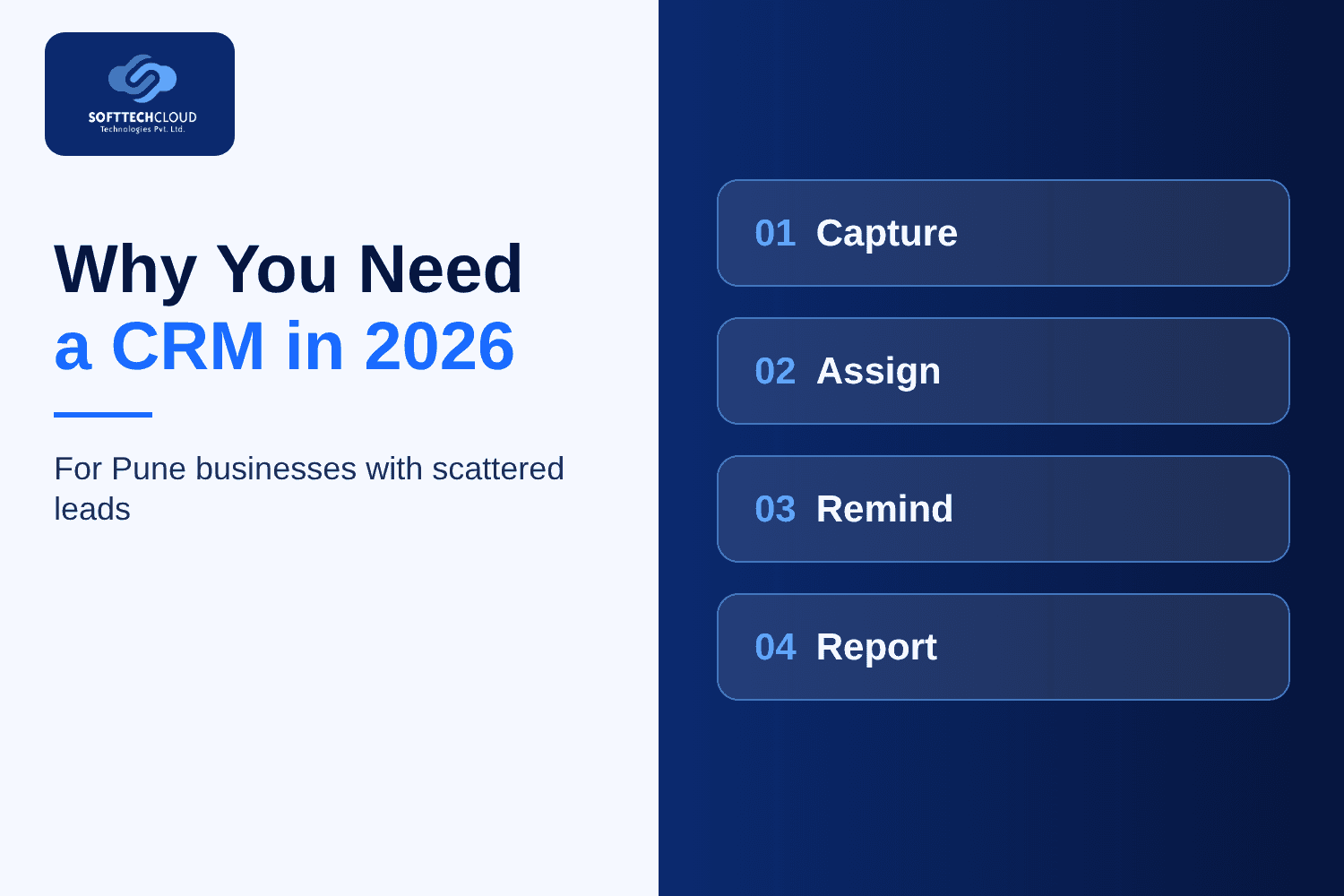
- Start small: capture, assign, remind, report. Add the rest later.
A CRM helps a Pune business by keeping every enquiry, call and follow-up in one shared record. Instead of leads sitting in WhatsApp chats, notebooks and spreadsheets, each one has an owner, a next step and a history, so fewer enquiries go cold and managers can see what is working.
This article is for owners, sales heads and marketing managers of service, trading and manufacturing businesses in Pune. It explains the problems a CRM solves, what to expect from one in 2026, and how to start without a large project.
1. The real problem: scattered leads
Think about where one customer's enquiry can start: a call to the office, a WhatsApp message to a salesperson's phone, a form on your website, a listing on a business directory, an ad, or a walk-in. Each channel often ends up with a different person, and each person keeps notes in their own way.
- The owner cannot see the whole pipeline without asking each person.
- A salesperson who leaves takes their chats and contacts with them.
- No one can say which channel produced the customers who actually paid.
- Follow-ups depend on memory, so quiet leads are forgotten.
2. Why speed of follow-up matters
A Harvard Business Review study of more than a million web-generated sales leads found that companies responding within an hour were nearly seven times as likely to qualify the lead as those responding even an hour later. The data is US-based and from 2011, so treat the number as a direction, not a promise for your business. The direction is clear: the first hour matters, and a CRM can alert the right person the moment a lead arrives.
3. What a CRM does for your team
| Need | What a CRM provides |
|---|---|
| Capture every enquiry | Leads from your website, forms and other channels land in one place, tagged by source |
| Assign quickly | Each lead gets an owner, by rule or by hand, with an alert |
| Follow up on time | Tasks and reminders tied to each lead |
| Remember the history | Calls, messages, quotes and notes on one customer record |
| Report honestly | Pipeline stages and source reports without rebuilding a sheet |
| Protect data | Role-based access, so not everyone can export the whole list |
4. Customer data and privacy rules
India's Digital Personal Data Protection Act puts duties on organisations that collect personal data, including consent and handling of customer records. A CRM does not make you compliant by itself, but it is a natural home for consent records, purpose notes and deletion requests. Our DPDP Act compliance checklist for websites covers what to review. Check dates and obligations against the official notification, or with your legal adviser.
5. Start small
- Capture: bring every lead source into one place.
- Assign: give each lead an owner within minutes.
- Remind: set a next action on every open lead.
- Report: review a simple pipeline and source report weekly.
- Then add what you actually need, such as WhatsApp or email connections and approvals.
We build CRMs around how your team sells, connected to the tools you already use, from our Hinjewadi office in Pune. Read about our custom CRM development, see why teams outgrow spreadsheets in CRM vs Excel for Pune businesses, or read the real estate CRM guide for a sector example.
Frequently asked questions
A CRM is software that keeps every customer and lead in one shared record, with owners, reminders and history, so your team does not depend on notebooks, chats or separate spreadsheets.
No. Small teams benefit once more than one person handles leads. The key is to keep the first version simple.
Any business that sells through enquiries and follow-up: services, trading, education, healthcare, manufacturing, real estate and IT companies.
Often yes, but it depends on the tools involved and their integration options. Confirm each connection during scoping.
No tool does that alone. A CRM can store consent and purpose records and support deletion requests, but you still need the right policies and processes.
List your lead sources, decide your pipeline stages, and pick a tool or a custom build that fits. Import your existing data and run it with a small team first.
Want to see what this would look like for your team? Contact us for a free requirements call.
Sources
- Harvard Business Review, "The Short Life of Online Sales Leads" (Oldroyd, McElheran and Elkington), March 2011: https://scholarsarchive.byu.edu/facpub/9711
IT & Marketing Head
More From The Team
A few related posts, picked from the same beat.