Your AI-Built Prototype Is Not a Product: What Breaks Between Demo and Launch (2027)
An AI-built prototype proves an idea can work. It does not prove the product is secure, reliable, affordable or owned. Here is what breaks between demo and launch, the verified data behind it, and a practical path to production.
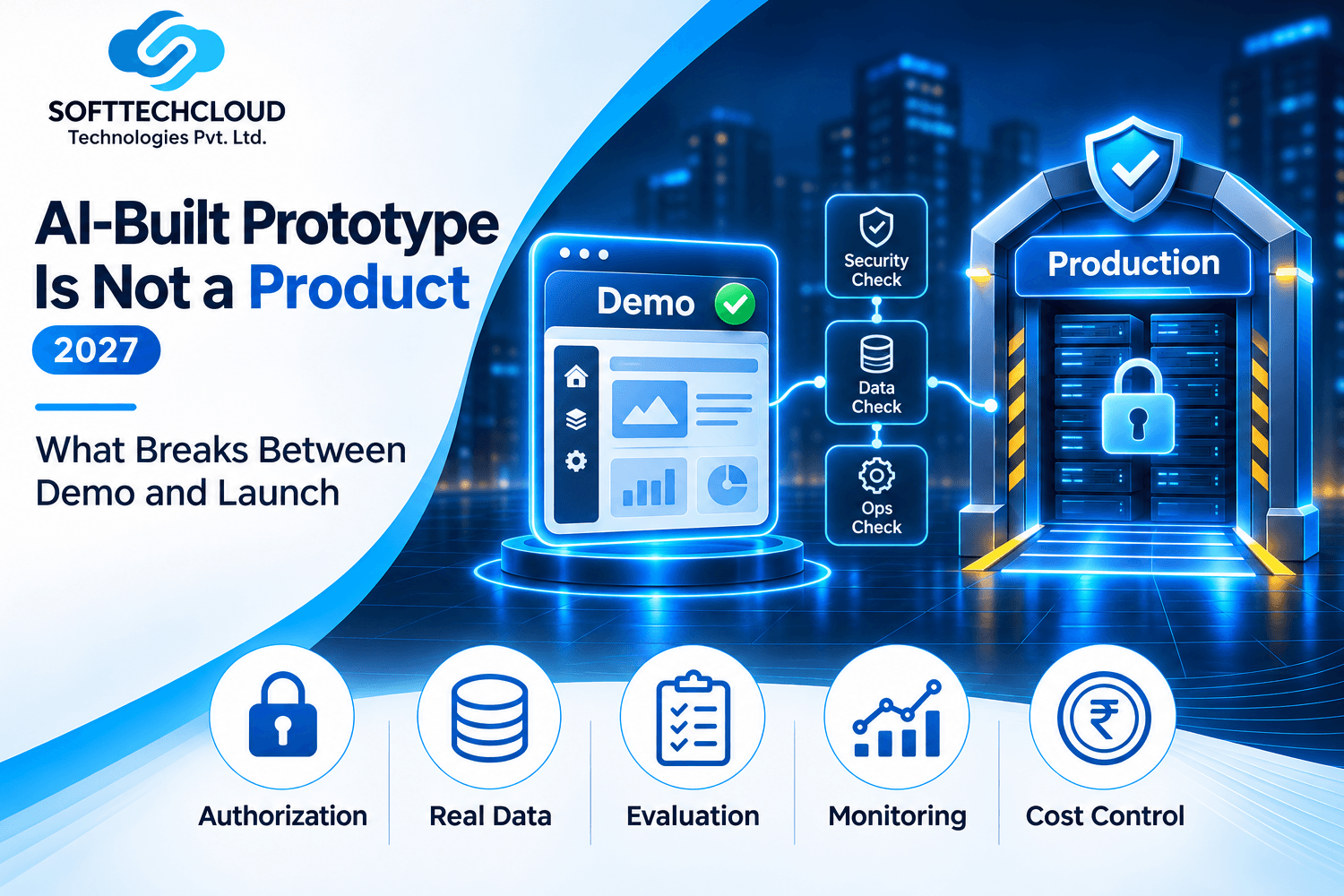
Quick answer: An AI-built prototype shows that an idea can work under ideal conditions. It does not show that the system is secure, reliable, observable, affordable or owned. The work that turns a demo into a product (data integrity, server-side authorization, error handling, evaluation, monitoring, cost control and a named owner) is still engineering work in 2027. Teams that move fastest treat the prototype as a specification and plan the production phase from day one.
Key takeaways
- A prototype proves possibility. A product proves repeatable, safe, accountable performance.
- In DORA's 2025 survey, 90% of respondents use AI at work, and 30% say they trust AI little or not at all.
- DORA links AI adoption to higher software delivery throughput, but ensuring software works as intended before release remains the main challenge.
- A Lovable-hosted app exposed 18,697 user records. The cause was inverted authentication logic in the backend, not an exotic attack.
- India's average breach cost reached INR 220 million in 2025, about 13% higher than 2024.
- Most gaps fall into eight break points: wrong problem, unrealistic data, no definition of correctness, weak evaluation, authorization in the wrong place, security added late, no operating model and unsustainable economics.
- Plan the production phase during the pilot, not after the demo impresses people.
What is an AI-built prototype, and why is it not a product?
A prototype answers one question: can this be built? A product must answer harder ones: should it exist, for whom, under what conditions, at what cost, and who is accountable when it fails?
| Dimension | Prototype | Product |
|---|---|---|
| Purpose | Demonstrate possibility | Deliver repeatable customer value |
| Success test | Works in selected examples | Works across intended users and conditions |
| Data | Curated, synthetic or small | Messy, changing, permissioned, sometimes regulated |
| Errors | Recoverable demo issue | Potential customer, financial or safety incident |
| Security | Often mocked or minimal | Identity, authorization, isolation, secrets, audit |
| Cost | Often hidden by free credits or low traffic | Measured cost per successful outcome |
| Change | Fast and informal | Versioned, tested, reviewed, reversible |
| Ownership | Builder-centric | Named technical and business accountability |
A prototype often uses synthetic data, a single admin account, hand-configured secrets and a permissive database policy. Those conditions can be fine for a controlled demo, as long as they are documented and nobody mistakes them for production controls. A demo recording is not a test report.
Why did demos break before AI? (the past)
The gap between a prototype and a production system is older than generative AI. Software teams have long known that a system which works for one friendly user on curated data can fail when real users arrive.
Before AI tools, prototypes often lacked error handling, security review, monitoring, backups and release management. Those omissions were tolerable in an experiment and expensive once users depended on the system.
Cloud platforms and DevOps reduced infrastructure work but did not remove engineering responsibility. A managed database still needs schema design, least-privilege access, backup verification and migration discipline. AI speeds up the coding step. It does not remove the rest of the lifecycle.
What does the 2025–2026 evidence show?
How widely is AI used, and how much do teams trust it?
The DORA 2025 State of AI-assisted Software Development report, a survey of nearly 5,000 technology professionals published on 23 September 2025, found that 90% of respondents use AI as part of their work, and more than 80% say it has enhanced their productivity. Yet 30% say they trust AI little or not at all. Source: DORA, State of AI-assisted Software Development 2025.
DORA describes AI as an amplifier: it magnifies an organization's existing strengths and weaknesses. On delivery, AI adoption is linked to higher throughput, but ensuring software works as intended before it reaches users remains the main challenge. Teams are moving faster, but their systems have not yet caught up to manage that speed safely.
What happens when AI-built backends lack server-side controls?
The clearest public example is a Lovable-hosted app reported by The Register in February 2026. Security researcher Taimur Khan reported 16 vulnerabilities, six of them critical, in one app. The app exposed 18,697 user records: 14,928 unique email addresses, 4,538 student accounts, and 870 users whose full personal data was exposed.
The root cause was ordinary. The app's Supabase backend had authentication logic that was inverted. Khan put it plainly: "The guard blocks the people it should allow and allows the people it should block."
Lovable said that acting on its security recommendations is at the discretion of the user, and that it acted on the disclosure within minutes. The lesson is not that one platform is uniquely unsafe. A "security included" promise does not move responsibility away from the team that ships the app. The same article cites Veracode's recent finding that 45% of AI-generated code contained security flaws.
What does a breach cost in India?
IBM's Cost of a Data Breach 2025 report put the average total organizational cost of a breach in India at INR 220 million in 2025, about 13% higher than INR 195 million in 2024. The findings most relevant to AI-built products:
- Only 37% of organizations in India have AI access controls in place.
- Nearly 60% either have no AI governance policy or are still developing one.
- Shadow AI (AI tools used without IT oversight) added INR 17.9 million to the average breach cost.
- 73% of those surveyed reported limited or no use of AI and automation in security. IBM also reports that using AI and automation cut breach costs by more than half.
Are founders investing, and what slows them down?
A survey of more than 200 founders and functional leaders by Elevation Capital found that 86% plan to increase AI investment in 2026. Among engineering teams, 85% of AI projects are in production. The top barrier is internal bandwidth: 53% of founders said limited bandwidth blocks adoption, and 54% said AI needs too much manual context to work reliably at scale.
That combination (high ambition, little spare capacity) describes many AI-built prototypes. Teams have the appetite to build fast and the constraint that stops them from hardening what they built.
What does regulation require, and when?
India has notified the Digital Personal Data Protection Rules, 2025. The rollout is staggered over roughly 12 to 18 months. Some provisions take effect immediately. Others, including consent manager registration and new consent obligations, apply after the transition period. Penalties can reach Rs 250 crore per breach for data fiduciaries, with a graded system meant to avoid overwhelming smaller businesses. After a breach, fiduciaries must notify affected individuals and the Data Protection Board.
For an AI-built product that handles personal data, consent, retention, access and breach response need to be designed now. Confirm exact commencement dates against the official notification before you commit to a timeline.
Which new security risks come with AI features?
OWASP's LLM06:2025 Excessive Agency describes how an LLM-based system can cause damage when it has too much functionality, permissions or autonomy. A malicious instruction hidden in an email or document can push an agent into actions the user never asked for.
OWASP's mitigations are practical: give extensions only the functions they need, limit their permissions to what each function requires, require user approval for high-impact actions, enforce authorization in downstream systems rather than trusting the model, and sanitise inputs and outputs. Logging and rate limiting do not prevent excessive agency, but they limit the damage when something goes wrong.
What specifically breaks between demo and launch?
Demos succeed under conditions that rarely hold in production: curated data, one friendly user, only the happy path, no concurrent load, no real attackers and no audit. Production removes all of these at once. The eight break points below are the ones we see most often.
Is the problem the right one?
A capability does not establish demand. "AI for contracts" describes what a model can do. A testable proposition describes who benefits and how: help procurement reviewers find specified supplier-risk clauses faster, with source evidence and legal approval before any action.
Check: Can you name the user, the job, the current alternative and the measurable pain?
Does the data look like the demo data?
Production data has missing fields, duplicates, outdated policies, conflicting records and access restrictions. Retrieval quality and permission enforcement become product concerns.
Check: Have you tested with messy real records? Can a user retrieve something they are not allowed to see?
What counts as correct?
A contract reviewer, a code assistant and a support tool need different acceptance criteria. For high-impact work, one average score hides the errors that matter. A style issue is not the same as a missed legal obligation or a wrong payment.
Check: Have you defined what must be detected, what may be omitted, when the system must abstain, and which outputs need human approval?
Is evaluation more than a few good prompts?
A handful of successful prompts shows possibility, not reliability. Production needs an evaluation set built from real workflows, known failures, adversarial inputs and out-of-scope requests. Test structured outputs with deterministic checks. Evaluate what an agent does, not only what it says. Re-run the evaluation whenever a model, prompt, tool or policy changes.
Is authorization on the server?
The inverted logic in the Lovable case is the pattern to watch for. Hiding an admin button does not stop a user from calling the endpoint directly. Every sensitive operation must check identity, role, resource ownership and tenant boundary on the server or in the data layer.
Check: Test negative cases. Can user A read, update, export or delete user B's records? Can a revoked user reuse an old token?
Is security part of the build, or a final scan?
Security is a property of requirements, architecture and implementation. For AI features, add prompt injection, tool misuse and excessive agency to the threat model. Treat retrieved documents and tool output as untrusted input. Keep secrets out of prompts, generated code and broadly readable logs. Require approval for sensitive or irreversible actions.
Who operates it after launch?
Launch starts operational responsibility. Someone must detect quality drops, run incident response, support customers, authorize rollbacks and turn failures into tests. Name an on-call owner, define severity levels, and monitor quality, cost, latency and safety alongside uptime.
Does the cost still work at real usage?
A cheap model call does not make a cheap workflow. Human correction, tool calls, retrieval, retries, support and compliance can dominate total cost. Measure cost per successful outcome, segment it by customer and workflow, budget agent execution, and test whether customers will pay at realistic usage.
What are the benefits of AI-built prototypes?
The benefits are real, and they are why this shift matters:
- Faster validation. Ideas that once took weeks of design and engineering can be tested in days.
- Cheaper learning. More experiments per unit of time, and each failure costs less.
- Stakeholder alignment. A clickable product makes an idea concrete for investors, executives and domain experts.
- Wider participation. Domain experts can surface ideas that might never reach an engineering queue.
- A living specification. Treated as a disposable or heavily evolved artifact, a good prototype is a concrete description of what production should do.
- Early user feedback. Limited, controlled exposure reveals usability and value problems that analysis misses.
The strategic benefit is more learning per unit of effort. It does not remove the need for engineering responsibility.
What are the drawbacks and losses?
Where do the losses come from?
| Loss | How it happens | Example |
|---|---|---|
| Financial | Rework, cloud spend, refunds, churn | Rebuilding a data model after launch |
| Opportunity | Automating the wrong workflow | A low-value feature consumes the roadmap |
| Trust | Wrong or unsupported output | Users stop relying on recommendations |
| Legal or privacy | Improper use or disclosure of data | Customer content processed outside agreed terms |
| Security | Unauthorized action or access | An agent exposes another tenant's records |
| Operational | Incidents and review burden | Support backlog after a quality regression |
| Team | Unreviewable output and debt | Generated changes outpace human understanding |
What hidden debt builds up?
- Decision debt: important choices exist only in prompts or generated code.
- Evaluation debt: the team cannot reliably compare versions.
- Context debt: product knowledge lives in private chats and individual memory.
- Integration debt: mocks do not match real systems.
- Governance debt: logs, retention and oversight are added late.
- Trust debt: early failures discourage later adoption.
How do you estimate the cost of downtime?
Use a formula, not a benchmark: Direct loss = affected transactions × contribution margin per transaction, plus incident response labour, customer credits, contractual penalties and recovery costs.
Avoid double-counting revenue and margin. Replace the example inputs with your own figures.
Illustration only: a B2B service that processes 120 billable events a day, with a contribution margin of INR 700 per event, loses about INR 84,000 of contribution margin during a four-hour interruption, if 30 events are expected per hour (4 × 30 = 120 events; 120 × INR 700 = INR 84,000). This excludes recovery labour, refunds and reputational effects.
Which framework should you use to decide readiness?
PROVE is SoftTech Cloud's internal planning framework. It is a synthesis for decision-making, not a published certification or external standard.
| Gate | Question | Minimum evidence |
|---|---|---|
| Problem | Is the problem important and recurring? | User research, workflow observation, baseline |
| Reliability | Does it work under intended conditions? | Evaluation, failure analysis, service objectives, rollback |
| Operations | Can the team run and support it? | Dashboards, alerts, owners, runbooks |
| Value | Does it create measurable benefit? | Pilot outcomes, adoption, retention, value signals |
| Ethics, economics, enforcement | Is it safe, affordable and governable? | Risk register, privacy and security review, unit economics |
Set thresholds before launch. A critical permission failure should not be offset by a good usability score. Name the stop conditions and the person who can accept residual risk.
Readiness can also be checked across six layers: problem (user, task, pain, success metric), solution (inputs, outputs, approval points, fallback), evidence (demo, pilot and production evidence are different things), engineering (architecture, tests, access control, observability, rollback), operations (owners, alerts, support, incident process) and commercial (budget, pricing, onboarding, margin).
How long does it take to go from prototype to launch?
It depends on risk and complexity. A low-risk internal tool with solid foundations can move in weeks. A customer-facing platform handling personal or payment data often takes months. Use this 90-day template as a starting point and adjust it:
What are the go-live gates?
- Business: the core journey and business rules are approved; support and ownership are assigned.
- Data: classification, retention, access, backup and restore have been reviewed.
- Security: critical vulnerabilities are fixed or formally risk-accepted; secrets are protected; authorization is tested.
- Quality: critical unit, integration and end-to-end tests pass; failure paths have been exercised.
- Operations: dashboards, actionable alerts, runbooks, rollback and incident contacts are ready.
- Commercial: customer commitments, service hours and vendor costs match what the system can actually do.
A "no-go" decision is a valid outcome. If a critical control is missing, delay the release, narrow the scope or restrict the audience.
Does the failure pattern change by industry?
Yes. The same gap shows up differently depending on the domain:
- CRM and sales: duplicate detection, consent, activity history, role-based visibility and audit trails. A demo can create a lead. A real CRM must preserve history and control who can see or export data.
- E-commerce: inventory consistency, payment idempotency, order states and refunds. A "payment successful" screen is not proof that the order ledger is correct.
- Healthcare and wellness: data classification, strict access control, auditability and jurisdiction-specific rules. Do not use real patient data in a prototype without a lawful basis and safeguards.
- Fintech and payments: identity, transaction integrity, fraud controls, reconciliation and segregation of duties. A balance that looks right on screen is not evidence of a correct ledger.
- Education and certification: exam integrity, learner privacy, payment records and reliable notifications. A failed notification can cause disputes even when the order went through.
- B2B SaaS: tenant isolation, SSO, provisioning and deprovisioning, audit logs and contractual service levels.
- Internal tools: employee access lifecycle, data quality, change management and continuity if the builder leaves. Internal does not mean low-risk.
What do 2027–2030 scenarios look like?
These are scenarios, not verified forecasts.
2027: differentiation moves to operations. As building gets easier, advantage may shift toward workflow integration, proprietary context, evaluation, security, trust and distribution. Buyers may ask for stronger evidence that agents stay within their permissions and budgets.
2028–2029: continuous assurance. Evaluation could shift from occasional benchmark runs to continuous workflow monitoring and risk-based release gates. Demand for deterministic controls, provenance and verifiable action boundaries may grow.
2030 and beyond: AI-native, human-accountable. A plausible model is one where AI handles high-volume synthesis and bounded execution, while people keep responsibility for goals, exceptions, governance and consequential decisions. A slower-adoption scenario is also plausible if reliability, integration costs or trust do not improve.
Signals to watch: real-world task success and human correction rates; customer willingness to delegate higher-impact actions; agent security incidents and the procurement rules they trigger; inference and tool costs relative to customer value; changes in privacy and liability rules; and how mature evaluation and observability tooling becomes.
What should each role do?
Founders: choose a narrow, recurring, expensive problem; use prototypes to learn, not to claim readiness; define accountability before customers arrive; track value and cost per successful outcome; treat security and privacy as product requirements.
CTOs and engineering leads: write an AI-assisted development policy covering approved tools, data handling, repository permissions, review, tests, secret scanning and release authority. Measure lead time, deployment frequency, change failure rate, recovery time and customer outcomes, not lines of generated code. Keep authorization and critical business rules in deterministic code outside the model.
Agencies and vendors: separate prototype, MVP and production scope in the contract. Define hosting ownership, source-code access, support period, backup and restore scope, and the change-request process. Do not imply that a demo includes an operational service.
Buyers: ask for architecture diagrams, data-flow maps, threat models, dependency inventories, test evidence, incident history, recovery objectives and exit or portability plans.
Frequently asked questions
No. Security depends on design, configuration, dependencies and operations. The Lovable case shows how one missing server-side check exposed data. It does not show that every AI-built app is unsafe. Review AI-generated code with the same rigour as any other code, and pay special attention to authorization, input handling and error paths.
A low-risk internal tool with solid foundations can take weeks. A customer-facing system handling personal or payment data often takes months. The biggest timing decision is starting the production assessment during the pilot instead of after it.
If the prototype was never designed for production constraints, rebuilding the weak foundations (schema, authentication, core services) is usually safer than patching it. Keep the prototype as the behavioural specification for the rebuild.
It needs the same process, with extra attention to where AI tends to fail: authorization logic, input validation, dependency choices, error handling and assumptions about business rules. "AI-generated" should never replace code review.
It means you have evidence for each claim: tests that pass, access controls tried with negative cases, a restore that has been rehearsed, monitoring that alerts a person, and a named owner. A completed checklist without evidence does not count.
Some provisions apply immediately, and others follow a staggered schedule of roughly 12 to 18 months from notification. Map your data flows, consent points, retention periods and breach response now, and confirm dates against the official notification.
Freeze new features, inventory what exists (data, accounts, integrations, assumptions), write down what success means, and run a short review of authorization, data handling and error paths. That review decides whether you stabilize the prototype or rebuild its foundations.
Production readiness checklist
Tick an item only when you have evidence. "Planned" is not "verified."
Product and requirements
- Target users, core journeys and business rules are documented.
- Acceptance criteria exist for critical workflows.
- Known limitations and excluded features are visible to stakeholders.
- Error, empty, loading and recovery states are designed.
- Customer-facing claims match what has been tested.
Architecture and data
- Architecture and trust boundaries are documented.
- A data-flow map identifies personal and sensitive data.
- Database constraints and indexes are reviewed.
- Migrations are versioned and tested on representative data.
- Retention, export and deletion procedures are defined.
Identity and security
- Authentication and account recovery are tested.
- Authorization is enforced server-side for every sensitive action.
- Tenant isolation is tested with negative cases.
- Secrets are not in source code or client bundles.
- Dependencies and build artifacts are scanned and reviewed.
- A threat model and incident contacts are documented.
Quality and release
- Critical unit, integration and end-to-end tests pass.
- Duplicate requests and retries are tested.
- Load and resilience tests reflect expected usage.
- CI/CD gates and code review are enabled.
- Rollback or forward-fix has been rehearsed.
- Every production deployment traces to a commit and artifact.
Operations and governance
- Logs, metrics, traces and actionable alerts are configured.
- Service objectives and escalation paths are defined.
- Backup restore has been tested.
- RPO and RTO are approved by the business owner.
- Support, incident communication and ownership are assigned.
- Cloud, model and vendor costs have budgets and alerts.
- Third-party contracts and data-processing terms are reviewed.
How SoftTech Cloud can help
We help teams take an AI-built prototype across the gap to production: workflow and data review, authorization and tenancy hardening, evaluation setup, observability and a staged launch plan. Where the right answer is to rebuild a weak foundation, we say so.
Related reading on this site: Why AI projects fail: the data readiness problem | DPDP Act compliance checklist for websites | Why your cloud bill doubled in 2026: a cost teardown | Meta Andromeda update and what advertisers should check
Explore our services: SEO and AI search visibility, data engineering, AI chatbots, AI agents and automation.
Have a prototype you want to take to launch? Talk to our team.
Sources
- DORA, State of AI-assisted Software Development (2025). https://dora.dev/research/2025/dora-report/
- The Register, "AI-built app on Lovable exposed 18K users, researcher claims" (27 Feb 2026). https://www.theregister.com/software/2026/02/27/ai-built-app-on-lovable-exposed-18k-users-researcher-claims/5038511
- IBM India Newsroom, "India Records Highest Average Cost of a Data Breach at INR 220 million in 2025" (7 Aug 2025). https://in.newsroom.ibm.com/2025-08-07-India-Records-Highest-Average-Cost-of-a-Data-Breach-IBM
- Elevation Capital, "The State of AI Adoption: What's Really Shifting Inside Indian Startups." https://ai.elevationcapital.com/blogs/state-of-ai-adoption-findings
- YourStory, "Govt notifies Digital Personal Data Protection Rules 2025; rollout stretched over 18 months" (Nov 2025). https://yourstory.com/2025/11/digital-personal-data-protection-dpdp-rules-2025-rollout-over-18-months
- OWASP GenAI Security Project, "LLM06:2025 Excessive Agency." https://genai.owasp.org/llmrisk/llm062025-excessive-agency/
General Manager
More From The Team
A few related posts, picked from the same beat.